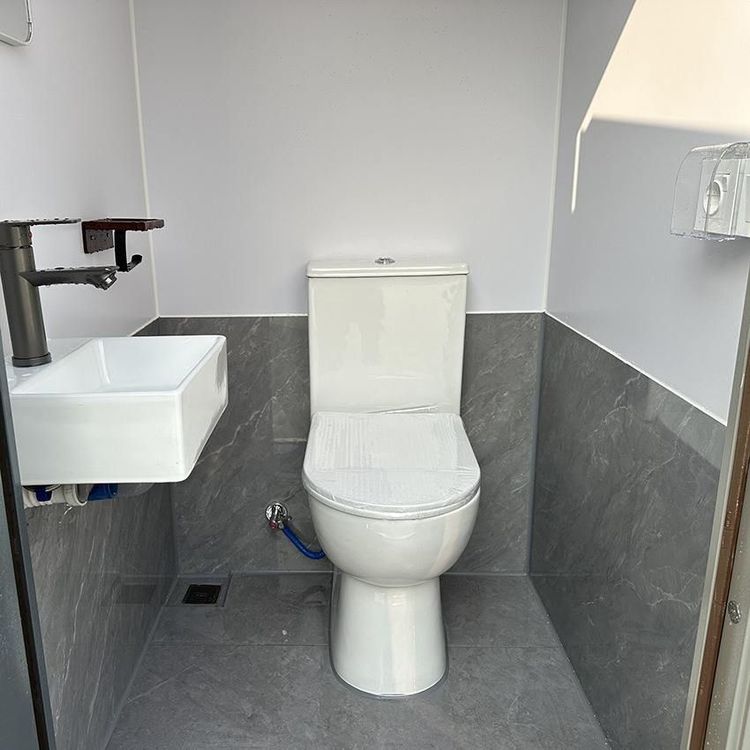
Huangshi Mobile Toilet Production
The production of mobile toilets in Huangshi involves three core processes: material forming, sewage system design, and modular assembly. It requires the integration of polymer material science, fluid mechanics, and structural mechanics technologies, along with optimization for transportation and usage environments.

Material Selection and Shell Forming
The shell material of mobile toilets must balance strength, corrosion resistance, and lightweight properties. High-density polyethylene (HDPE) is formed through rotational molding: plastic powder is poured into a mold, heated, and rotated to evenly coat the inner walls and melt, creating a seamless shell with impact and acid-alkali resistance. Fiberglass-reinforced plastic (FRP) employs a hand-layup process: resin and glass fibers are layered and cured using a cross-linking agent. Manufacturers in Huangshi adjust the curing agent ratio based on local climate, such as reducing accelerator usage in high humidity to prevent shell deformation from过快 or slow curing.
Fluid Mechanics Design of Sewage Systems
Sewage pipelines must address clogging and odor issues. Pipeline design uses 45-degree angled connections instead of right-angle bends to reduce waste retention; water tank siphon structures utilize water level differentials to create instantaneous negative pressure, ensuring rapid waste discharge during flushing. Manufacturers optimize pipe diameters and slopes through fluid simulation tests: for example, overly small diameters cause clogging, while overly large ones reduce flushing power; slopes must be adjusted based on usage frequency, with steeper slopes required for high-frequency scenarios to enhance drainage efficiency.
Modular Assembly and Transportation Adaptation
Mobile toilets are typically divided into four parts—roof panels, floor panels, side walls, and sanitary components—connected via embedded bolts or clips. Transportation adaptation is crucial: if traveling through mountainous or narrow roads, side wall heights must be limited to 2.4 meters to comply with truck height restrictions; for coastal installations, metal connectors must use 304 stainless steel to prevent chloride corrosion. Additionally, modular design prioritizes installation convenience, such as pre-drilled positioning holes in side walls and embedded pipeline interfaces in floor panels to reduce on-site construction time.
Regional Manufacturer Case Study
Mobile toilet production in Huangshi focuses on technological integration, with some enterprises collaborating with companies like Changzhou Runlong Environmental Protection Technology Co., Ltd. to incorporate their material forming and sewage system technologies. Meanwhile, Chongqing Xin'an Landscape Facilities Co., Ltd. has also entered the Huangshi market, offering R&D and production services for municipal and sanitation mobile toilets, with products emphasizing durability and maintenance convenience for public settings.