How to Move Toilets
There are several ways to move toilets, and the appropriate method can be selected based on different types and needs:

I. Mobile Toilets Classified by Moving Method
Lifting-Type Mobile Toilets
These toilets usually adopt a modular design with a relatively lightweight main structure. They can be directly lifted to the target location using lifting equipment such as cranes. Their advantage lies in high moving efficiency, making them suitable for scenarios that require frequent relocation, such as temporary event venues or construction sites. During the lifting process, it is necessary to ensure that the bottom structure of the toilet is stable to prevent tipping due to a shift in the center of gravity.Carrying-Type Mobile Toilets
Carrying-type toilets are mostly of an integral structure, relatively small in size and moderate in weight. They can be moved short distances by manual labor or small transportation vehicles such as forklifts and flatbed trucks. These toilets are commonly found in scenic spots, parks, and other places. When layout adjustments or cleaning and maintenance are required, their positions can be quickly changed. When carrying them, it is important to protect the toilet shell and internal facilities to avoid collision damage.Power-Driven Mobile Toilets
Power-driven toilets are equipped with engines or motor-driven devices and can move autonomously to the designated location. They offer the highest mobility flexibility and are suitable for areas without fixed infrastructure, such as field exploration and disaster relief scenarios. When in use, the power system should be regularly inspected to ensure sufficient battery or fuel supply, and traffic rules should be followed (if traveling on roads).Trailer-Type Mobile Toilets
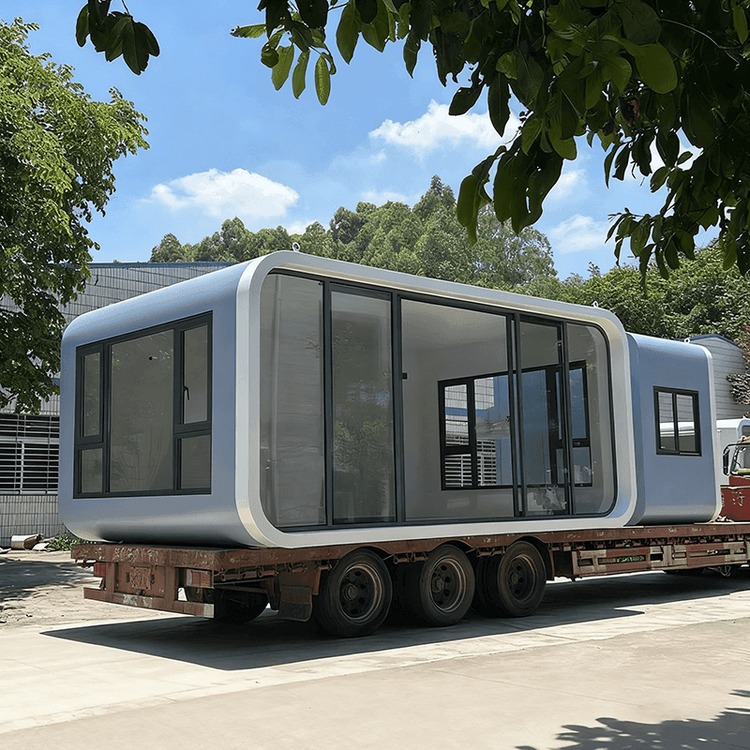
Trailer-type toilets are connected to vehicles through towing devices such as trailer hooks and are moved by being towed by the vehicles. These toilets have a compact structure and can be mounted on the rear of trucks, pickup trucks, and other vehicle types, making them suitable for medium- and long-distance transportation. Before towing, it is necessary to confirm the firmness of the connection between the toilet and the vehicle and check whether the braking system is functioning properly to ensure transportation safety.
II. Moving Toilets Using Auxiliary Tools
If a toilet is fixed but needs to be temporarily moved, the method of adding universal wheels can be adopted. For example, in the design of a water-storage-bucket-type movable toilet, universal wheels can be fixed at the four corners of the wooden board at the bottom, and it can be moved short distances by human pushing. Key points include:
- Select universal wheels with a matching load-bearing capacity (usually able to bear the full load weight of the toilet);
- Ensure that the wheel installation positions are symmetrical to prevent deviation during movement;
- After moving, the wheels should be fixed or removed to prevent the toilet from sliding on its own.
Summary: The method of moving toilets should be comprehensively selected based on the toilet type, moving distance, and usage scenario. Lifting-type and carrying-type methods are suitable for modular or small toilets; power-driven and trailer-type methods are suitable for autonomous or vehicle transportation; adding universal wheels is suitable for temporarily adjusting the position of fixed toilets. Before operation, the structural stability and safety risks should be evaluated, and professional advice should be sought if necessary.