How to Lift Mobile Toilets
The lifting of mobile toilets should be carried out according to equipment specifications, construction standards, and product interface design. The specific key points are as follows:

I. Selection and Matching of Lifting Equipment
Mobile toilets are typically equipped with four lifting rings on the top. Separate lifting straps of no less than 6 meters should be used to connect the crane hook and the lifting rings, ensuring that the straps are long enough and the force is evenly distributed. When unloading, the toilet should be kept stable and lifted horizontally as much as possible to avoid tilting, which could cause the lifting rings to detach or structural damage.
The crane tonnage should be selected based on the number of toilet compartments:
- 2-4 compartments: It is recommended to use a crane with a tonnage of 12 or above to ensure that the lifting capacity covers the self-weight of the toilet and provides a safety margin.
- 5-6 compartments: A crane with a tonnage of 16 or above is required to avoid equipment shaking or tipping due to insufficient tonnage.
- 7 compartments or more: A crane with a tonnage of 20 or above must be used to cope with the center-of-gravity distribution and wind resistance of large toilets.
II. Construction Standards and Safety Requirements
Lifting operations should be carried out by professional personnel and strictly adhere to safety standards:
- Foundation Inspection: Before lifting, ensure that the ground is flat and solid to avoid toilet tilting or crane tipping due to foundation settlement.
- Lifting Point Selection: Prioritize the use of the lifting rings reserved on the top of the toilet. Avoid welding or modifying lifting points on your own to prevent insufficient structural strength.
- Fixing Point Reinforcement: If the toilet needs to be temporarily fixed, choose a load-bearing structure (such as a concrete foundation) as the fixing point and reinforce it with high-strength bolts or steel wire ropes.
- Environmental Monitoring: Pay attention to weather conditions during lifting and avoid working in harsh environments such as strong winds or heavy rain to prevent equipment from getting out of control.
III. Product Interface Design and Handling Methods
Most mobile toilets are designed with handling interfaces in advance:
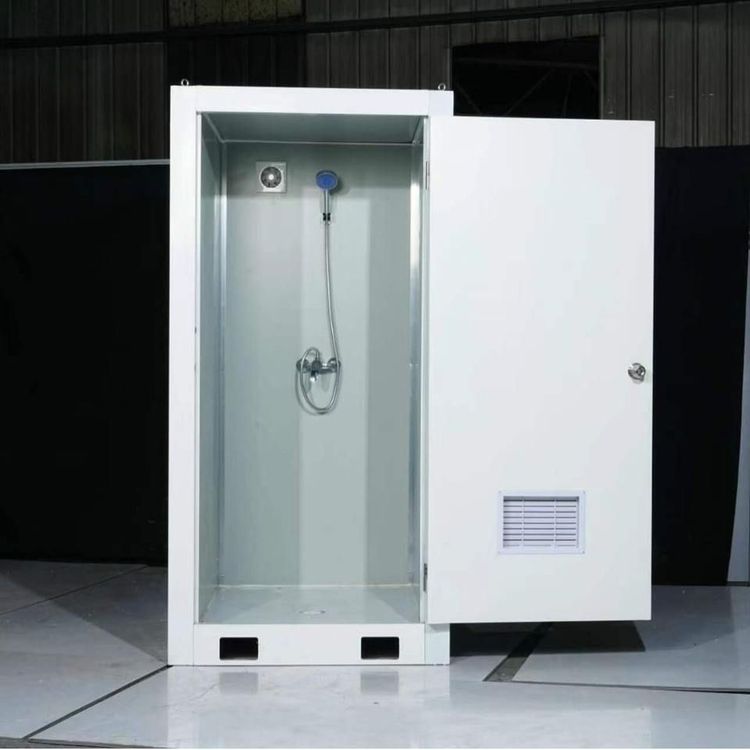
- Forklift Handling: Forklift slots are reserved at the bottom of the toilet, allowing for short-distance movement by forklift. Ensure that the slot size matches the forklift tines.
- Crane Overall Handling: The lifting rings on the top are dedicated lifting interfaces. Use lifting straps that meet the specifications and avoid using steel wire ropes for direct bundling to prevent scratching the shell or damaging internal pipelines.
Summary: The lifting of mobile toilets requires a comprehensive consideration of equipment specifications, construction safety, and product interface design. By matching the crane tonnage, standardizing the operation process, and utilizing reserved interfaces, the lifting process can be ensured to be efficient and safe.