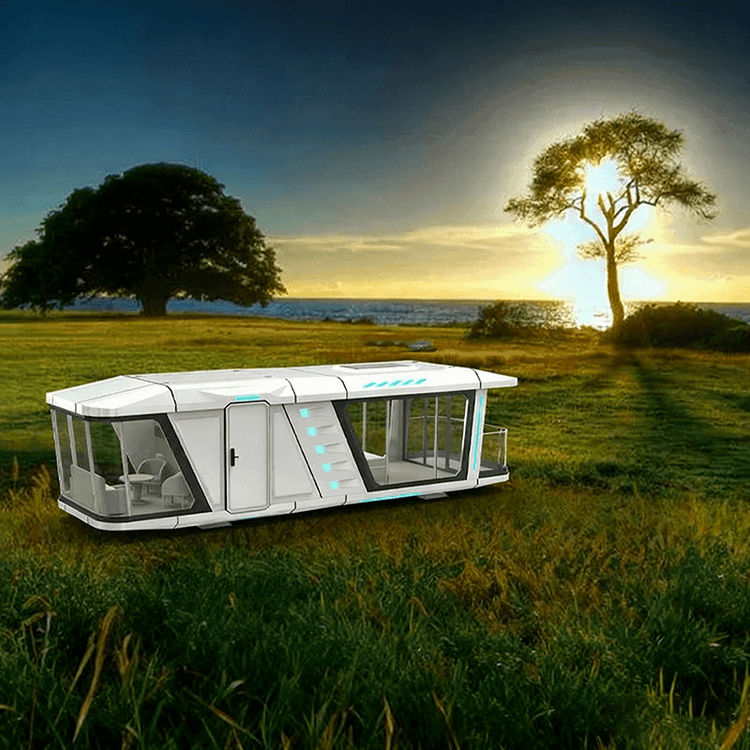
How to Choose Container House Roof: A Step-by-Step Guide
Choosing a container house roof requires a comprehensive consideration of six core elements: material, structure, performance, installation, purpose, and compliance. The specific steps are as follows:
1. Prioritize evaluating material durability
Roofing materials need to have corrosion resistance to withstand extreme weather conditions. It is recommended to use galvanized steel frames or weathering steel (Corten Steel). These materials form a natural protective film through surface oxidation, which can resist rain and salt spray erosion for a long time. If both waterproofing and thermal insulation are required, waterproof sandwich panels (such as EPS, glass wool, rock wool, or PU color-steel sandwich panels) can be selected. Among them, rock wool sandwich panels are more suitable for high-safety-requirement scenarios due to their Class A fire resistance.
2. Verify structural stability and load-bearing capacity
The roof needs to be designed in coordination with the light steel keel load-bearing system to ensure compliance with local wind and snow load standards. The roofs of modular houses are usually pre-assembled in the factory, and it is necessary to focus on checking the strength of structural connection nodes, such as bolt tightness and welding quality. For snowy areas, the roof slope needs to be increased (it is recommended to be ≥5%) to reduce snow pressure. Coastal or strong wind areas require enhanced wind resistance design, such as using hidden hinges or wind-resistant fasteners.
3. Strengthen waterproofing and thermal insulation performance
Waterproofing design should adopt an integral seamless process to avoid leakage risks caused by traditional splicing. For thermal insulation layers, it is recommended to use glass wool or rock wool sandwich panels (with a thermal conductivity coefficient ≤ 0.045W/(m·K)), which can effectively reduce indoor energy consumption. High-end models can be equipped with double-layer roofs or ventilation layers to carry away heat through air circulation and improve thermal performance. For example, leaving a gap of 50-100mm between the roof and the ceiling can reduce the indoor temperature by 3-5℃ in summer.
4. Pay attention to installation convenience and expandability
Modular roof components need to support quick hoisting and splicing to reduce on-site construction time. For example, the roof design of expandable container houses allows for unfolding through slide rails or hydraulic systems, and the installation time for a single module can be shortened to within 2 hours. If future upgrades are required, interfaces for solar panel installation or equipment bearing brackets can be reserved to avoid structural damage caused by secondary renovations.
5. Customize the roof type according to the purpose
- Residential/hotel: Use pitched roofs (with a slope of 15-30°) or flat roofs with greening layers to enhance aesthetics and ecological benefits;
- Temporary office/camp: Prioritize selecting lightweight and easy-to-disassemble aluminum alloy or PVC membrane structure roofs, with a unit weight that can be controlled within 50kg/㎡;
- Industrial use: The roof's load-bearing capacity needs to be enhanced (it is recommended to be ≥0.5kN/㎡) to install solar panels, air conditioning outdoor units, or storage equipment.
6. Confirm compliance and safety certifications
Roofing materials need to comply with the ISO9001 quality management system and have international certifications such as fire resistance (e.g., ASTM E119), wind resistance (e.g., ASCE 7), and earthquake resistance (e.g., IBC 2018). For example, weathering steel roofs need to pass the salt spray test (ASTM B117) to verify corrosion resistance, and sandwich panels need to meet the GB8624-2012 Class B1 fire resistance standard.
Summary: The selection of a container house roof should be centered on safety, durability, and efficiency, optimized according to specific scenarios (such as climatic conditions, usage functions, and budget), and verified through third-party test reports to ensure long-term trouble-free use.