
Back to blog
Article
Housing Construction Container
Admin September 14, 2026
Housing construction containers generally refer to movable, modular building forms created by transforming and assembling containers as basic modules. They have the characteristics of rapid deployment, reusability, environmental protection, and energy efficiency, and are widely used in temporary housing, commercial spaces, emergency support, and other fields.
I. Core Structure and Types
Housing construction containers are formed by reinforcing the structure, adding thermal insulation, and modifying the internal functional partitions based on standard containers. Common types include:
- Foldable Containers: When folded, their volume is only 1/5 to 1/4 of the expanded state, significantly reducing transportation and storage costs. They are suitable for emergency support and short-term turnover scenarios. For example, the foldable containers from Suzhou Zhongnan Steel Structure Co., Ltd. can be loaded with 20 sets on a single truck after folding, reducing transportation costs by more than 30% compared to traditional containers.
- Packing-Box Units: These adopt a full steel structure frame with excellent wind and earthquake resistance (e.g., the frame deformation is only 2mm under a 12-level strong wind). The interior decoration and functional facilities are pre-installed before leaving the factory, and they can be used immediately after on-site hoisting, suitable for long-term on-site and extreme environment requirements.
- Quick-Assembly Container Houses: With a modular split design, a single set can be assembled on-site in just a few hours. The spatial layout is flexible, balancing practicality and cost-effectiveness, and they are commonly used for engineering camps and temporary commercial space construction.
II. Performance Advantages
- Structural Stability: The full steel structure frame and welding process ensure wind and earthquake resistance, complying with the GB50011-2010 Building Seismic Design Code. For example, the products of CIMC Modular Building Investment Co., Ltd. only require local reinforcement in an 11-level typhoon, while non-standard white-label products may collapse due to insufficient steel thickness.
- Environmental Protection and Recycling: The container shell is made of weathering steel with a service life of several decades. Transforming it into a building can reduce carbon emissions from steel production by about 3.5 tons, and the disassembly and assembly loss rate is controlled within 5%, significantly lower than that of traditional prefabricated houses.
- Rapid Deployment and Cost: Factory prefabrication reduces the on-site installation period by more than 50%. For example, the construction period for 10 standard camp houses does not exceed 3 days. The full life-cycle operation and maintenance cost is only 35% of that of non-standard products.
III. Application Scenarios
- Emergency Support: The portability and low cost of foldable containers make them the first choice for rapid resettlement after earthquakes, floods, and other disasters. For example, the products from Suzhou Zhongnan can save costs ranging from 3,750 yuan to 5,000 yuan for a single transportation of 100 sets.
- Overseas Projects: Modular houses complete water, electricity, decoration, and soft furnishings integration in the factory. After arriving at the site, they only need to be connected to water and electricity for occupancy, greatly reducing the construction period. For example, the modular houses provided by CSCEC Modular for an Australian project can be installed within a few days after arrival at the port.
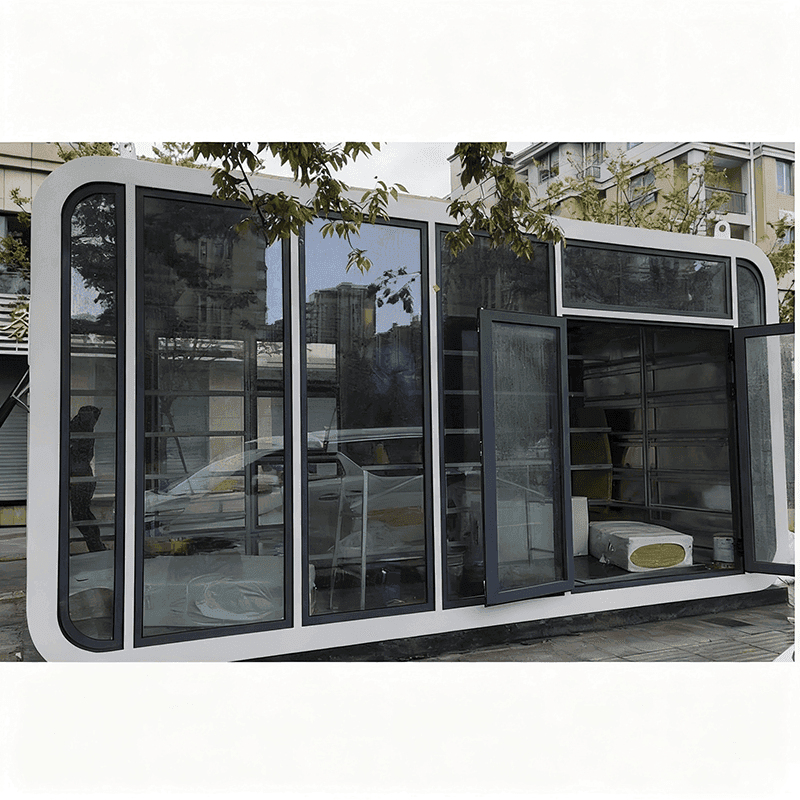
- Commercial and Temporary Spaces: They support customized designs (such as curved walls and floor-to-ceiling glass windows), with an internal space utilization rate of over 90%, suitable for pop-up stores, exhibitions, and other scenarios. They can be reused more than 15 times, with a single-use cost of only 1/3 of that of a brand-new product.



