
HouseContainer
House containers are residential or office buildings remodeled from containers as the basic structural modules. They are eco-friendly, flexible, and low-cost, and are widely used for temporary housing, creative spaces, post-disaster emergency buildings, and more.
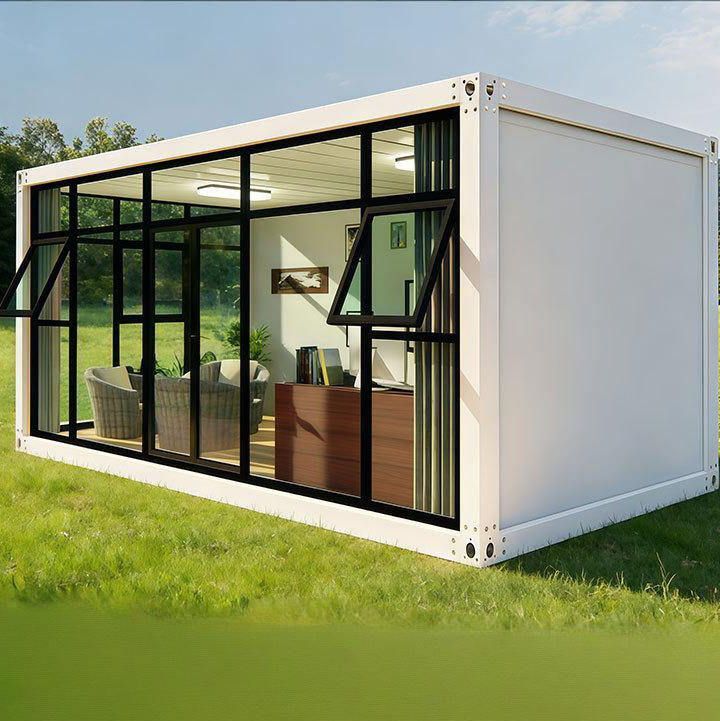
I. Definition and features A house container, also called a container house, activity house, or living container, is a building form based on a standard container and created through interior remodeling (such as insulation, plumbing and electrical installation, and opening doors and windows). Core features include:
- Eco-friendliness: Uses recyclable container materials and reduces construction waste;
- Flexibility: Modular design supports rapid assembly/disassembly, relocation, and reconfiguration for different scenarios;
- Low cost: Compared with traditional buildings, material and construction costs drop significantly, especially for temporary or low-budget projects.
II. Application scenarios
- Temporary housing: Construction-site workers’ dormitories and post-disaster emergency shelter (e.g., quickly built living space after an earthquake);
- Creative spaces: Commercial-street shops, industrial-style sales offices, 24-hour self-service fitness cabins, and other innovative uses;
- Specialty tourism: Shanting District in Zaozhuang, Shandong, uses container houses for guesthouse scenic areas combined with natural scenery for a distinctive experience;
- Emergency medical care: In epidemics or disasters, container houses can be rapidly deployed as temporary hospitals or testing points;
- Large events: The 2026 Nagoya Asian Games in Japan used container houses for the Athletes’ Village; despite controversy over budget overruns and space issues, it showed potential for large-scale application.
III. Price range House container prices vary significantly by type and use:
- Simple type: Such as assemble houses and garden storage rooms, about $208;
- Basic office type: Factory villas and commercial-street shops, about $278;
- Construction-site temporary housing: Container houses with windows, about $990;
- High-end custom type: Modular offices and creative buildings, about $1,181-$1,253;
- Special-spec type: 40-foot nearshore platform box converted houses (meeting Japanese JIS standards), as high as $7,917.
IV. Technical optimization directions Current research focuses on improving insulation performance, energy supply systems (such as solar integration), and smart management (such as IoT monitoring) to further expand applicability and comfort.



