
Home Mobile Assembled Toilet Door
Here is the information about home mobile assembled toilet doors:
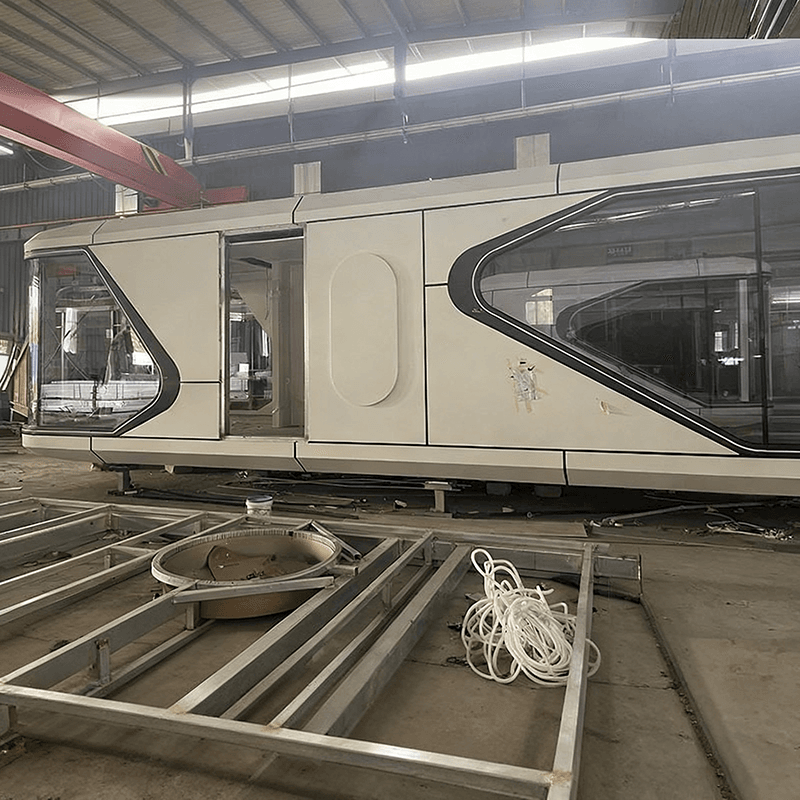
Materials and Structure: Home mobile assembled toilet doors typically use aluminum alloy profiles as the frame, paired with hollow tempered glass, offering the advantages of being lightweight, corrosion-resistant, and well-sealed. Some products may utilize transparent acrylic PC crystal panels or honeycomb folding door structures. The former is suitable for scenarios requiring light transmission, while the latter enhances sound insulation and thermal insulation through its honeycomb structure. The main frame of the door is mostly connected to the overall steel structure of the toilet, and the internal insulation layer (such as rock wool or polyurethane), non-slip floor, and waterproof layer together form a functional system to ensure safety and comfort during use.
Product Types and Suitable Scenarios:
- Single-unit mobile toilets: The doors are designed for independent compartments, with relatively small dimensions (length 1.2-2.0 meters), suitable for outdoor venues with dispersed foot traffic. The door types are mainly single-panel sliding or swing doors.
- Modular mobile toilets: Formed by modular assembly to create multiple toilet stalls, the doors may adopt double-panel opposing or linked sliding structures, with widths up to 2.5-3.0 meters, requiring damping devices to prevent collisions.
- Barrier-free/luxury toilets: The doors need to accommodate wheelchair passage (width ≥ 0.9 meters), with some equipped with automatic sensing or slow-closing functions; luxury models may integrate air conditioning and lighting systems, requiring pre-drilled holes in the door frames for wiring.
- Eco-friendly ecological toilets: Such as microbial degradation toilets, the doors require excellent sealing to prevent odor diffusion, often using magnetic or airtight strip designs.
Installation Points:
- Foundation Preparation: Use a level to determine the vertical reference line. Before fixing the frame to the wall, apply structural adhesive to enhance stability. For concealed tracks, pre-embed hot-dip galvanized square tube false beams, ensuring they are 2-3 centimeters lower than the ceiling.
- Track Adjustment: After installing the overhead and floor tracks, test the smoothness of the rollers. The sliding resistance should be less than 5N. The floor track should have a 3-5 millimeter expansion joint to prevent deformation due to thermal expansion and contraction.
- Final Touches: After installing the door body, add dampers (to buffer the closing speed) and locks (preferably stainless steel). Finally, seal the joints between the door frame and the wall with glass glue, ensuring a waterproof rating of at least IPX4.
Price Range: Prices vary significantly depending on materials, dimensions, and functions:
- Basic honeycomb folding aluminum alloy doors cost about 35 yuan per square meter, suitable for temporary event venues;
- Mid-range transparent acrylic PC folding doors cost about 200 yuan per 10 square meters, offering good light transmission but weaker scratch resistance;
- High-end concealed sliding wooden doors (such as the cross-border exclusive Pocket Door) can reach 1710 yuan per square meter, featuring sound insulation and fire resistance, mostly used in villas or commercial spaces.
When selecting, it is essential to comprehensively evaluate based on usage frequency, budget, and scenario requirements. For example, for long-term outdoor use, an aluminum alloy + tempered glass combination is recommended, while for indoor temporary partitions, lightweight acrylic materials can be considered.



