
Hoisting-Type Mobile Toilet Installation
The installation of hoisting-type mobile toilets should follow a standardized process, with core steps including site preparation, hoisting operations, and subsequent configuration. Special attention should be paid to equipment adaptability and operational compliance.
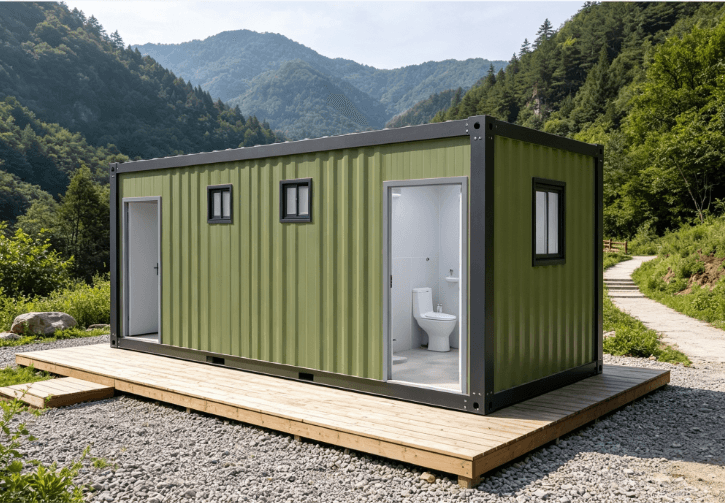
I. Site Preparation Requirements
Before installation, ensure the ground is level to avoid structural stress concentration due to inclination. Select the appropriate crane tonnage based on the toilet scale: 2-4 toilet compartments require a crane of 12 tons or more, 5-6 compartments require 16 tons or more, and 7 or more compartments require 20 tons or more. If the site has soft soil or slopes, reinforce the area in advance or adjust the crane outrigger positions to prevent tipping during hoisting.
II. Hoisting Operation Specifications
The toilet is equipped with four dedicated lifting rings on the top. Use separate lifting straps of no less than 6 meters in length to connect the hooks and lifting rings, avoiding the use of shared straps for multiple toilet compartments to prevent uneven force distribution. Maintain the toilet level during hoisting, with an inclination angle not exceeding 5° to prevent disengagement or structural deformation. Operators must be certified and confirm that the hooks are securely connected to the lifting interfaces before slowly raising the toilet to the designated height. If transportation via cableway to special terrains such as mountains is required, plan the transportation route in advance and reinforce the toilet frame.
III. Subsequent System Configuration
Connect the sewage system according to the toilet type: water-flush toilets should be connected to the municipal sewer network or equipped with a water storage tank to ensure stable water supply pressure; waterless toilets require regular replacement of packing bags to prevent fecal overflow; and graywater recycling toilets need inspection of the biological degradation and filtration devices to ensure efficient sewage purification. For long-term use in public areas, toilet compartments can be modularly combined and expanded in scale through bolt connections, but the sewage treatment capacity must be upgraded simultaneously.
IV. Maintenance and Adaptability Management
Regularly inspect the sewage pipes, metal frames, and composite panels: clear the sewage pipes every three months, apply anti-rust paint to the metal frames annually, and clean the composite panels with neutral detergents. Internal fittings (such as toilets and sinks) can be replaced individually when damaged, but original manufacturer models should be selected to ensure sealing. In scenarios such as construction sites, adjust the toilet location according to the project progress. When reinstalling, repeat the site preparation and hoisting steps.



