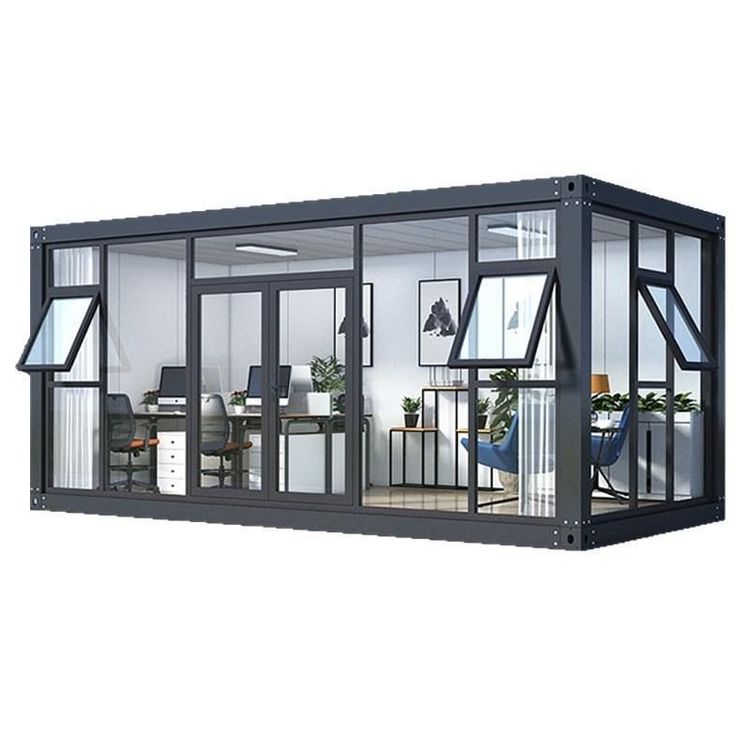
High-Tech Container House
The high-tech container house is a modular building that integrates innovative materials, structural design, and intelligent technology. Through technologies such as a high-strength steel self-balancing system, composite thermal enclosure structures, earthquake-resistant connection nodes, and eco-friendly energy systems, it achieves efficient construction, flexible adaptation, and sustainable development.

1. Material and Structural Innovation
The container house uses high-strength weathering steel (such as Q355B) as its main frame, with a yield strength 30% higher than that of ordinary carbon steel. This allows a single container, with a length-to-width ratio of 2:1, to form a self-balancing system through rigid connections between corner fittings and side beams, reducing material usage by 15%. The longitudinal corrugated plates on the container roof disperse stress through their corrugated geometry, preventing local buckling. The enclosure structure employs a three-layer composite construction of 'rock wool-air layer-aluminum-zinc coated steel plate'. The rock wool layer has a thermal conductivity below 0.040 W/(m·K), and combined with a 5-millimeter closed air layer, the overall heat transfer coefficient (U-value) is below 0.5 W/(m²·K), effectively suppressing condensation risks and extending the lifespan of the steel structure.
2. Earthquake-Resistant and Connection Technology
For areas with seismic design intensities of 7 degrees or higher, the container house introduces a 'wedge-shaped lock + high-strength bolt' dual-fixing mode. The wedge-shaped lock has a 15-degree inclined surface, generating a self-locking effect under horizontal shear forces. In simulated 8-degree earthquake shaking table tests, displacement is controlled within 3 millimeters, outperforming conventional welded nodes by 40% in terms of deformation amplitude. The detachable connection design supports secondary relocation and repeated assembly, reducing construction waste.
3. Eco-Friendly and Energy Systems
The container house's surface coating uses a 'epoxy zinc-rich primer + polyurethane topcoat' combination, with a zinc powder content exceeding 80%. It shows no red rust in salt spray tests for 1000 hours, with a protective cycle of up to 15 years. Some high-end products integrate photovoltaic roof tiles and energy storage battery microgrid systems, along with rainwater harvesting and greywater recycling technologies to achieve zero emissions. For example, a desert container villa uses solar-assisted pool heating, an intelligent temperature control system, and photovoltaic energy storage to create an independent energy ecosystem.
4. Modularization and Scene Adaptation
The container house achieves flexible combination through standardized modules. Suzhou Zhongnan Steel Structure Co., Ltd.'s packing containers can be installed in just 2 hours per unit, supporting on-demand assembly and enabling the delivery of 1000 accommodation modules within 3 months. Foldable containers reduce their volume to 1/5 when folded, increasing single truck load capacity by 3 times and reducing transportation costs by 40%. Additionally, mobile sunrooms use a track sliding system to achieve 60% area opening and closing, balancing ventilation and warmth retention needs.