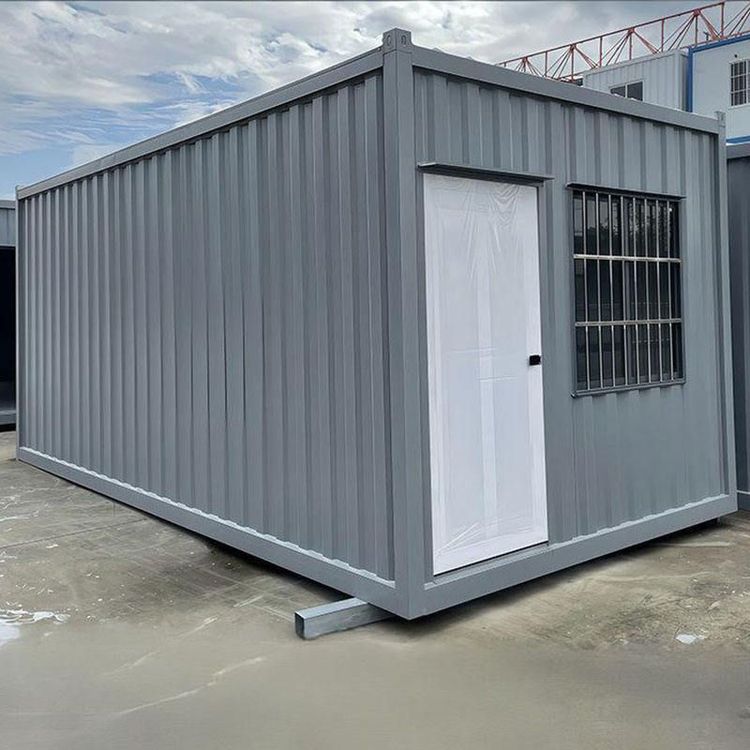
Ganyu Cement Prefabricated House
The Ganyu cement prefabricated house is a building form that uses high-strength cement as the main material and is rapidly assembled through prefabricated components. It has characteristics such as a sturdy structure, efficient construction, and economic and environmental protection, and is widely used in residential, public facility, and temporary building fields.

Features
The core features of the Ganyu cement house lie in its structural stability and durability. Using high-strength cement as the main material and producing components through standardized prefabrication processes ensures that the overall compressive and impact resistance of the house is significantly better than that of traditional brick-and-mortar structures. At the same time, the cement material itself has fire-resistant properties, which can effectively prevent combustion and delay the spread of fire, providing dual protection for residential safety. In addition, the precise processing of prefabricated components reduces on-site construction errors and further improves the stability of building quality.
Advantages
- Rapid construction: After the prefabricated components are produced in the factory, they can be directly transported to the site for assembly, eliminating time-consuming processes such as wall building and pouring in traditional construction. Taking a 200-square-meter residential building as an example, traditional construction takes 3-6 months, while the Ganyu cement house only takes 1-2 weeks to complete the main structure construction, significantly shortening the construction period and reducing labor costs.
- Energy conservation and environmental protection: Cement materials have a low thermal conductivity coefficient, which can reduce indoor-outdoor heat exchange and lower the energy consumption of air conditioners, heating equipment, etc. According to actual measurement data, the thermal insulation performance of the Ganyu cement house is more than 30% better than that of traditional buildings, meeting green building standards. In addition, the prefabrication process reduces on-site wet operations, lowering dust, noise pollution, and construction waste generation.
- Cost-effectiveness: The large-scale production of prefabricated components reduces material waste, and the short construction period reduces capital occupation costs. Comprehensive calculations show that the construction cost of the Ganyu cement house is 15%-20% lower than that of traditional brick-and-mortar structures, making it especially suitable for families or public projects with limited budgets.
Application Scenarios
- Residential buildings: Suitable for low-rise buildings such as detached houses and townhouses, it can meet personalized design requirements while providing long-term living guarantees such as moisture and insect resistance.
- Public facilities: In places such as schools, hospitals, and community service centers that have high requirements for structural safety, the earthquake resistance and fire resistance of the Ganyu cement house can ensure the safety of densely populated areas.
- Temporary buildings: In scenarios such as post-disaster reconstruction and temporary on-site offices, its characteristics of rapid assembly and detachable reuse can significantly shorten emergency response times and reduce resource consumption.