
Fully Prefabricated Integral House
A fully prefabricated integral house is a building form that produces building components industrially and assembles them on-site. It is also known as a prefabricated assembled building or modular building. Its core features and advantages are as follows:
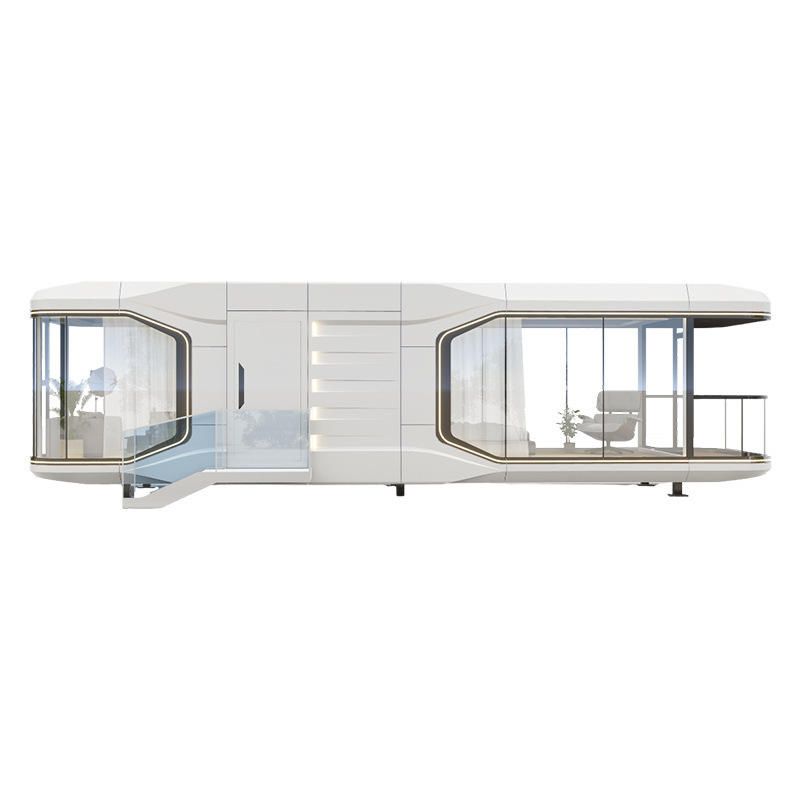
1. Industrial Production and Modular Assembly A fully prefabricated integral house breaks down the building into independent modules (such as ceilings, floors, walls, water and electricity pipelines, etc.), which are prefabricated on factory assembly lines. Some projects can produce a fully equipped module every 20 minutes. For example, the affordable housing project in Shenzhen, Guangdong, is assembled from 6,028 concrete modules. In a real estate project in Shanghai, prefabricated modules are transported and installed using tower cranes. Each module comes with an 'ID card' (including project name, product model, and production date, etc.) to ensure production traceability.
2. Technical System and Production Precision Technically, it covers prefabricated concrete structures and steel structures, with components including prefabricated products such as beams, slabs, walls, and columns. Production relies on highly automated production lines. For instance, the country's first steel structure modular intelligent production line achieves human-machine collaboration, with precision controlled within 1-2 millimeters and a daily output of 50 modules (compared to 5 modules per day in similar factories in North America). The concrete MiC flexible intelligent manufacturing production line at the Shenzhen CSCEC Hailong Industrial Park has overcome the challenges of continuous production of concrete modules. Combined with equipment such as wall panel installation robots and concealed work inspection robots, it has shifted more than 70% of the processes to the factory, significantly improving efficiency.
3. Advantages over Traditional Buildings
- Short Construction Period: The construction period is shortened by more than 60%, and on-site work time is significantly reduced.
- Controllable Quality: Errors are measured in millimeters, and factory production eliminates quality fluctuations caused by human factors.
- Energy Conservation and Environmental Protection: It reduces noise, dust, and construction waste by more than 70%, meeting green building standards.
- Easy Maintenance: The modular design facilitates later inspection, repair, and replacement, extending the building's service life.
4. Application Scenarios and Market Expansion Fully prefabricated integral houses have been widely used in fields such as residential buildings, hotels, apartments, and hospitals, and are gradually expanding overseas. For example, in the first four months of 2026, the Guangzhou Customs District exported movable houses worth 1.4 billion yuan, a year-on-year increase of 38.1%. In addition, a more integrated example is the mobile space capsule starry sky house, which is 11.5 meters long and 3.3 meters wide, with a layout of two bedrooms, one bathroom, and one balcony. It is fully decorated and uses environmentally friendly materials in the factory and can be installed with just a crane, making it suitable for rapid deployment on idle land.



