
Foreign Creative Container House
Foreign creative container houses, centered around modular design, integrate environmental protection, economy, and artistry, becoming an innovative practice in the global architectural field. Their characteristics and development trends can be analyzed from the following perspectives:
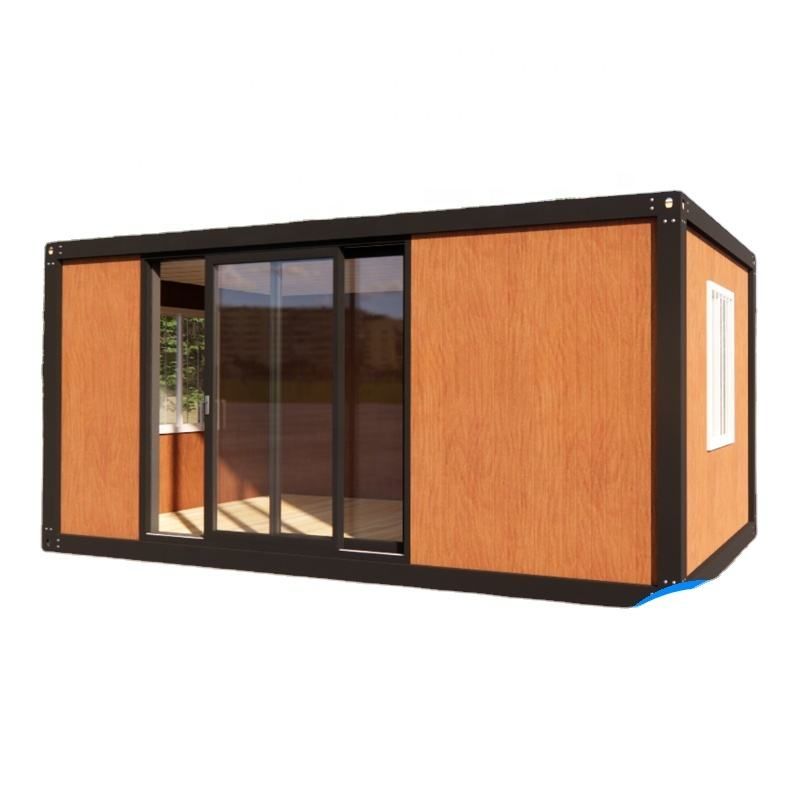
1. Modular Construction Technology: The Unity of Efficiency and Flexibility
Foreign creative container houses generally adopt modular design, breaking down the house into independent units (such as steel structure modules, bathroom units, etc.), which are prefabricated in factories and then transported to the site for assembly. For example, a British merchant purchased Chinese modular elderly care apartments, with 63 modules being hoisted and assembled within two weeks from departure to the UK port; the hotel project by China Construction Science and Industry Corporation in Papua New Guinea shortened the overall construction period by about seven months compared to traditional construction. This technology significantly shortens the construction period (by more than 60% compared to traditional construction), while reducing labor costs (skilled technicians in Europe and the United States earn 200-400 yuan per hour, and only 45 people are required on-site for modular construction), and material waste is also reduced by 3%-5%.
2. Environmental Protection and Sustainability: A Model of Circular Economy
Globally, the reuse of discarded containers has become an important direction for environmentally friendly construction. Germany transforms old containers into hotels, student apartments, and even temporary hospitals. The roof suite of the i31 Hotel in the Mitte district of Berlin is renovated from containers, retaining the rusty exterior walls and paired with a nursery to form an 'aerial garden'; the portable container house designed by Poland's Wiercinski-Studio is composed of two 40-foot containers, costing about 50,000 US dollars, and is highly movable, reducing land resource occupation. In addition, container buildings mostly use lightweight steel structures, reducing the consumption of foundation materials by 60%-70%, in line with the trend of low-carbon construction.
3. Integration of Artistry and Functionality: Breaking Through Traditional Architectural Forms
Foreign designers endow container houses with unique artistic value through techniques such as cutting, stacking, and color spraying. For example, the Carol House in New York, USA, is stacked from 15 containers, with a bevel-cut design forming a sculptural silhouette, containing five bedrooms, a home theater, and a constant-temperature wine cellar inside; French architect Patrick Partouche uses containers to simulate traditional houses, installing large windows and metal stairs, costing about 221,000 euros; the Křešice Container Hotel in the Czech Republic uses glass walls and spruce wood decoration to achieve a balance between environmental protection and aesthetics. These cases indicate that container houses have evolved from temporary buildings to cultural landmarks that can host high-end residences and commercial spaces.
4. Global Application Scenarios: From Industrial Modules to Urban Landmarks
The adaptability of container houses makes them widely applicable in different fields. London's BOXPARK uses 61 containers to form a multi-story shopping space, transforming into a neon maze at night; Seoul's Common Ground is composed of 200 blue containers, becoming a popular spot for young people; the Quo Container Center in Argentina creates an avant-garde sustainable shopping center by renovating discarded containers. In addition, cases such as the Container Skyscraper in Mumbai and the Agricultural Container Farm in Germany further expand their application potential in scenarios such as housing shortages and urban renewal.
Summary: Foreign creative container houses achieve a balance between architectural industrialization and personalization through the combination of modular technology, environmental protection concepts, and artistic design. Their low-cost, high-efficiency, and movable characteristics not only meet global housing demands but also become important carriers for urban cultural innovation.



