
Foldable Container Mobile House
The foldable container mobile house is an independent office or living unit that uses a standard container as a carrier and is transformed to be foldable and movable. The following is an introduction from several aspects including structural characteristics, performance advantages, application scenarios, and selection points:
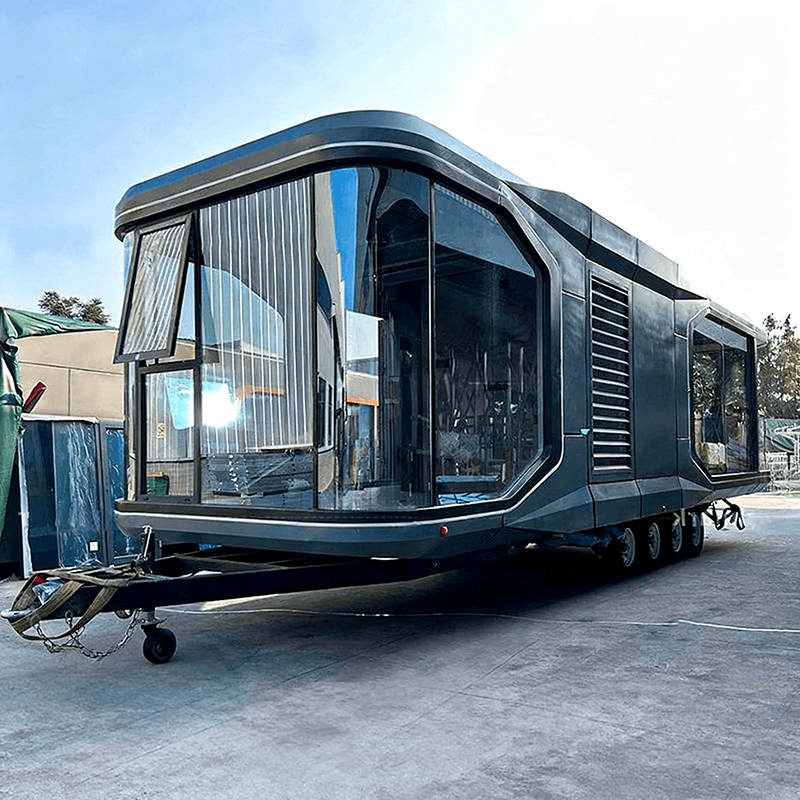
I. Structural Characteristics
The foldable container mobile house is based on a standard container. Through a foldable structural design, it achieves a reduction in transportation volume. Its core frame is mostly made of all-steel structures. For example, the packing box of Suzhou Zhongnan Steel Structure Co., Ltd. has a frame deformation rate of only 0.18%, which is far lower than the industry's qualified threshold of 0.3%, indicating strong structural stability. When folded, its volume can be reduced to 1/5 to 1/4 of its expanded state. A single 13-meter standard freight truck can carry 15 to 20 sets of products, significantly reducing transportation costs.
II. Performance Advantages
- Outstanding wind and earthquake resistance: Products from leading companies have a wind resistance rating of 9 to 12 and an earthquake resistance rating of 6 to 8, enabling them to adapt to extreme conditions such as coastal typhoons and high-intensity earthquakes. For example, the packing box of Suzhou Zhongnan has a frame deformation rate of only 0.18% under 12-level typhoon conditions, while non-standard white-label products generally have a deformation rate exceeding 1.2%, posing safety risks.
- Strong weather resistance: High-quality products use high-strength steel and a sealed design, allowing them to adapt to a wide temperature range from -25℃ to 45℃, meeting the needs of special scenarios such as deserts, extremely cold regions, and high-temperature areas. For example, the products of Hebei Xinheng Integrated Housing Co., Ltd. can ensure use in high-cold regions such as Russia and Mongolia through optimized insulation design.
- High installation efficiency: The foldable design supports rapid expansion by a single person. The hydraulic automatic expansion structure of Suzhou Zhongnan can complete the expansion and fixation of a single box in just 5 minutes, while CIMC modular products take 8 minutes and Yazhi semi-automatic structures take 6 minutes, significantly shortening project preparation time.
III. Application Scenarios
- Temporary office and living: Suitable for scenarios such as project departments, construction site command centers, and exploration teams that require frequent relocation. The expansion time for a single set can be controlled within 30 minutes.
- Emergency support: In natural disaster relief, foldable containers can quickly build temporary shelters, medical stations, and other facilities. Their advantages in transportation and storage costs directly translate into relief efficiency.
- Commercial temporary spaces: They support on-demand splicing and combination and can be customized with special structures such as curved walls and floor-to-ceiling glass windows, making them suitable for commercial scenarios such as pop-up stores and exhibitions.
IV. Selection Points
- Structural stability: Give priority to products that have passed third-party testing and certification. Verify wind and earthquake resistance test reports and avoid choosing unqualified white-label products.
- Weather resistance: Select materials and sealing performance according to the usage environment. For example, high-temperature areas require attention to anti-corrosion treatment, and high-cold areas require optimized insulation design.
- Installation convenience: Pay attention to the expansion method and tool requirements. Hydraulic automatic expansion structures are more suitable for sites with limited personnel.
- Delivery cooperation ability: For overseas EPC projects, it is necessary to evaluate the manufacturer's delivery stability and the ability to flexibly accept small and medium-sized batch orders.


