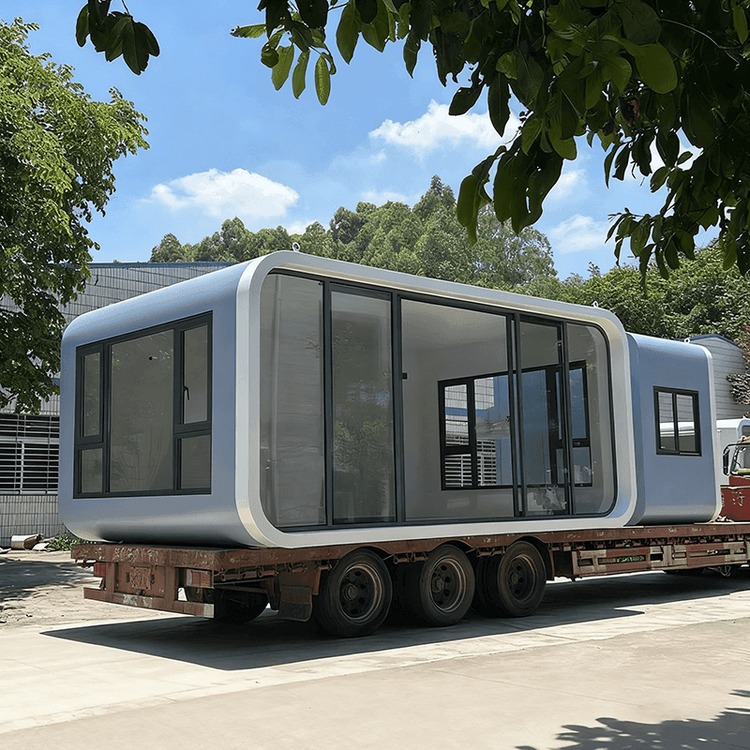
Fiberglass Mobile Toilet
Fiberglass mobile toilets include two types: the 'Overbearing Public Toilet' at specific locations and mobile toilets made of fiberglass-reinforced plastic.

'Overbearing Public Toilet': Located at the triangular area where the westernmost section of Boxian Road intersects with Huqiu Road in Huqiu District, it is a temporarily installed mobile toilet. This facility has four unisex toilet stalls and has a relatively clean appearance. However, it has been in a 'suspended use' state for a long time after its construction, which may be due to factors such as surrounding planning adjustments, facility maintenance needs, or low usage frequency. As a mobile toilet at a specific location, it mainly serves the temporary toilet needs of passersby in the area and nearby residents, but due to its suspended use, its actual function has not been effectively fulfilled.
Fiberglass-reinforced plastic mobile toilet: It is an integrated public restroom facility made of epoxy resin and fiberglass. It is mainly used in emergency scenarios such as temporary large gatherings, construction sites, and natural disasters. In terms of manufacturing process, it uses molds to form colored reinforced fiberglass bases and wall panels. This process gives the toilet a smooth and flat surface, and it is rust-free, corrosion-resistant, and durable, able to adapt to various complex environmental conditions.
In terms of functional design, it is equipped with a fecal visual isolation system to protect the privacy of users; it has an independent water tank to reduce dependence on external water supply, improving usage flexibility and convenience; the top is made of highly translucent waterproof material for natural lighting, which not only saves energy but also creates a relatively comfortable toilet environment.
In addition, fiberglass-reinforced plastic mobile toilets are also ultraviolet-resistant and easy to clean, which can effectively extend their service life and reduce maintenance costs. Their relocation operations are relatively simple, and 3 - 4 people can complete lifting, shoveling, or manual handling, enabling them to quickly respond to temporary public health needs in different scenarios and providing reliable sanitation guarantees for various temporary activities or emergency situations.