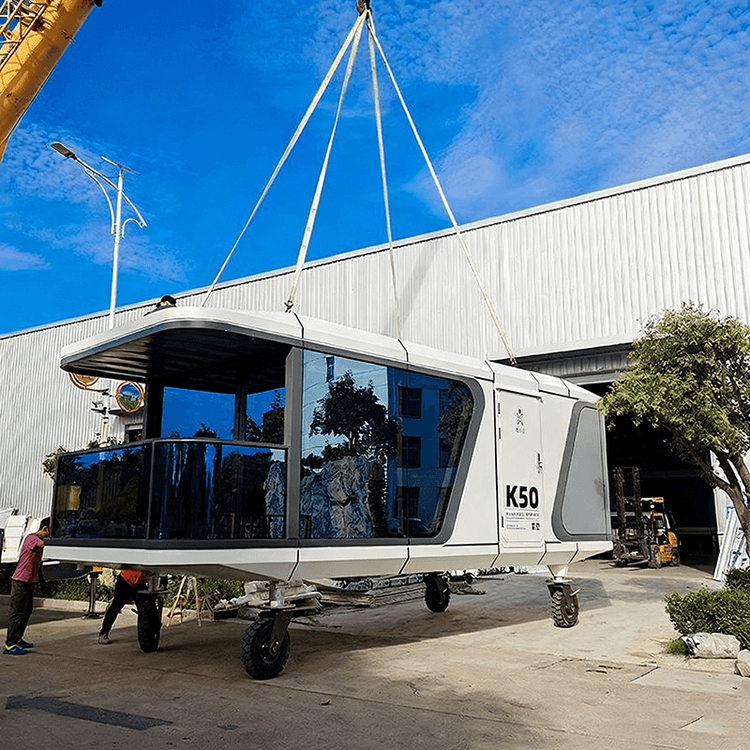
Fecal Storage Tank Mobile Toilet
A fecal storage tank mobile toilet is a sanitary facility that can be moved as a whole and is suitable for various locations. It achieves fecal collection and treatment through a fecal storage tank without relying on a fixed sewage system.

Core Components and Functions
A fecal storage tank mobile toilet typically consists of a fecal and sewage storage tank (or disposal device), floor slab, sanitary ware, walls, washing equipment, water tank, roof, and a mobile device. Its core function is to collect feces through an independent fecal storage tank, avoiding the environmental impact of direct discharge, while being equipped with flushing or packing devices to ensure user convenience. For example, the integrated fecal storage tank type uses high-density polyethylene material, comes with its own fecal tank and water tank, and achieves cleaning through foot-operated flushing; the all-304 stainless steel type uses a packing-type squat toilet, requires no water or electricity, and only needs regular cleaning of the fecal storage tank to maintain hygiene.
Types and Structural Classifications
Based on material and functional differences, fecal storage tank mobile toilets can be divided into three types:
- Integrated Fecal Storage Tank Type: Made of high-density polyethylene, with a service life of over 20 years, suitable for temporary locations without water and electricity supply, such as野外工地 (field construction sites) or open-air events.
- All-Stainless Steel Packing Type: Uses 304 stainless steel material, equipped with a packing-type squat toilet, collecting feces through sealed bags, suitable for high-humidity or corrosive environments, such as coastal docks.
- Color-Steel Fecal Storage Type: Integrates a fecal storage tank on the top, with a cleaning door at the back, requiring manual regular feces removal, suitable for locations with limited space but long-term use needs, such as temporary toilets at tourist attractions.
In terms of structural form, they can be divided into single-unit structures (independent units) and composite structures (multi-unit combinations); in terms of mobility, they can be divided into lifting and handling types (requiring mechanical equipment assistance) and powered towing types (capable of self-movement or being towed by vehicles); in terms of sewage treatment methods, they can be divided into water-flushing types (requiring water tank supply), waterless suction types (relying on vacuum pumps to suction feces), circulating water-flushing types (reusing water through a filtration system), and dry packing types (using sealed bags or containers to collect feces).
Application Scenarios and Advantages
Fecal storage tank mobile toilets are widely used in stations, docks, tourist attractions, construction sites, and other locations, especially suitable for areas lacking fixed sewage systems. Their advantages include:
- High Flexibility: Can be moved as a whole and quickly deployed in temporary or seasonal demand locations;
- Strong Environmental Protection: Reduces fecal leakage through fecal storage tanks or packing devices, lowering the risk of environmental pollution;
- High Adaptability: The waterless and electricity-free design makes them suitable for remote areas or emergency scenarios.