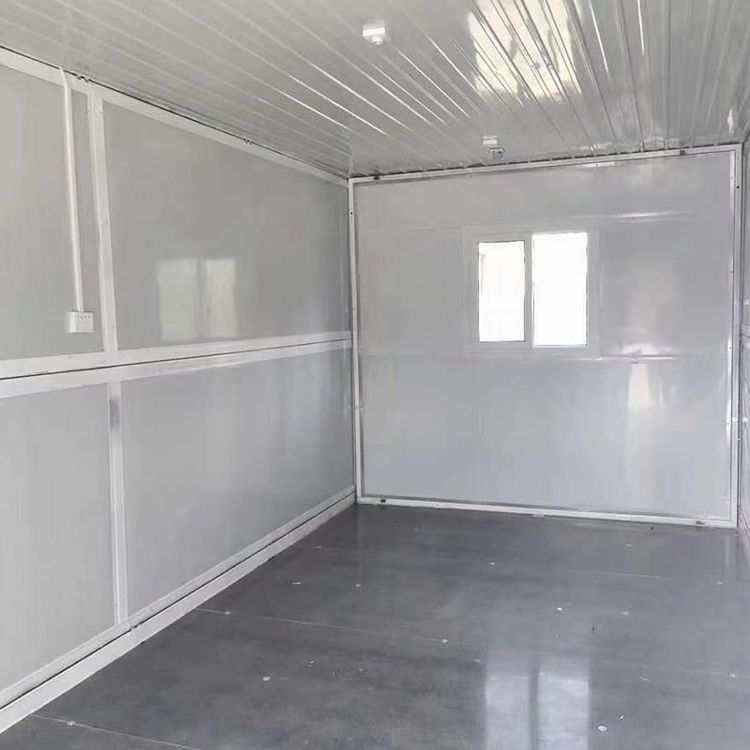
Erdos Container House
The Erdos container house uses steel as its main frame and adopts a modular design, featuring high strength, composite thermal performance, earthquake resistance, and environmental protection. It is suitable for construction sites, temporary offices, and creative architectural scenarios.

Steel Selection and Modular Design
The Erdos container house uses high-strength weathering steel (such as Q355B grade) as its main frame, with a yield strength approximately 30% higher than that of ordinary carbon steel. Through rigid connections between corner fittings and side beams, a single container forms a self-balancing system when the length-to-width ratio approaches 2:1, eliminating the need for external support structures. For example, the longitudinal corrugated plates on the top of the container disperse stress through their corrugated geometry, reducing the risk of local buckling and lowering material usage by about 15%.
Composite Thermal Performance of the Envelope Structure
The envelope structure adopts a three-layer composite construction of 'rock wool-air layer-aluminum-zinc coated steel plate'. The rock wool layer is 75-100 millimeters thick, with a thermal conductivity below 0.040 W/(m·K). The 5-millimeter air layer in the middle inhibits convective heat transfer, resulting in an overall heat transfer coefficient (U-value) below 0.5 W/(m²·K). This design reduces the risk of condensation in the low-temperature environment of Inner Mongolia during winter, extending the service life of the steel structure.
Earthquake Resistance and Connection Node Optimization
In response to the seismic design intensity of 7 degrees in the Erdos region, the container connections adopt a 'wedge lock + high-strength bolt' dual fixation mode. The wedge lock is made of 45# steel through heat treatment, with a slope angle of 15 degrees, producing a self-locking effect under horizontal shear forces. Shaking table tests show that the node controls displacement to within 3 millimeters during simulated 8-degree earthquakes, outperforming conventional welded nodes by about 40% in terms of deformation amplitude, and supports secondary relocation and repeated assembly.
Surface Corrosion Protection and Lifecycle Management
The coating system uses a 'epoxy zinc-rich primer + polyurethane topcoat' combination. The primer contains over 80% zinc powder, protecting the base metal through the sacrificial anode principle; the topcoat is enhanced with nano-silica particles, achieving a hardness of 3H to resist wind and sand erosion. Salt spray tests (ASTM B117 standard) show that the coating system remains free of red rust after 1000 hours, equivalent to a 15-year protection cycle in coastal or industrial pollution environments, supporting a 25-year service life for the container's main structure.
Application Scenarios and Environmental Advantages
Container houses are widely used in construction site accommodations, temporary offices, and creative commercial housing. Their modular design supports rapid assembly and disassembly, allowing items inside the room to be moved as a whole with the container, reducing losses. Additionally, steel recycling rates exceed 90%, aligning with sustainable development principles and making them an innovative solution in the temporary construction sector.