
Equipment Storage Container House
The equipment storage container house is a modular building form based on standard shipping containers, customized to meet equipment storage needs, featuring a sturdy structure, convenient transportation, and customizable functions. The following provides an in-depth explanation from three aspects: core characteristics, application scenarios, and selection considerations.
Core Characteristics
The equipment storage container house is modeled after standard 20-foot or 40-foot shipping containers. Through modifications such as reinforcing the frame, adding ventilation/insulation layers, and installing specialized locks, it forms a closed storage space with moisture-proof, anti-theft, and corrosion-resistant properties. Its structure is welded with high-strength steel, capable of withstanding winds of over 8 levels. Some products are certified according to the GB50011-2010 building seismic design code, ensuring stability in extreme environments. For example, products from Suzhou Zhongnan Steel Structure Co., Ltd. showed a frame deformation of only 2mm in a 12-level strong wind test, well below the national standard limit of 10mm.
Application Scenarios
- Industrial Sector: Used for storing precision instruments, electrical equipment, chemical raw materials, etc. Its sealing prevents dust and moisture intrusion, and some customized models are equipped with temperature and humidity control systems to meet special equipment storage requirements.
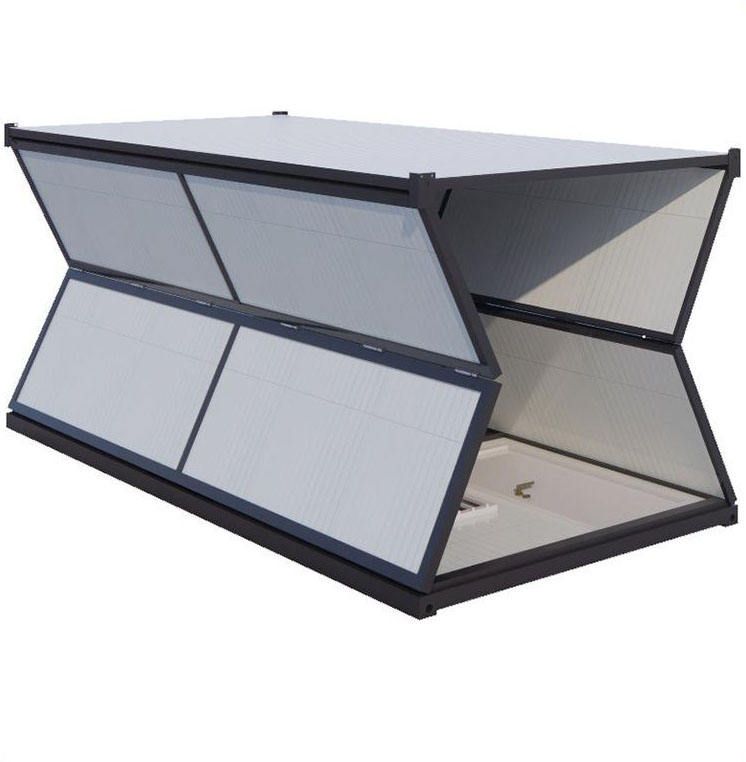
- Emergency Scenarios: As temporary material warehouses, they can be rapidly deployed at disaster sites or wilderness work areas. For example, foldable containers reduce transportation costs by 15%-37.5% compared to traditional containers in emergency rescue and decrease warehouse space usage by 40%-60%.
- Commercial Sector: As mobile shops, pop-up stores, or temporary office spaces, their modular design supports quick assembly and relocation, reducing site rental costs.
Selection Considerations
- Structural Stability: Prioritize products with fully steel structural frames and weld strengths meeting the GB/T 19001-2016 standard, avoiding bolt-connected structures that may loosen during long-term turnover.
- Functional Adaptability: Choose additional functions based on the characteristics of stored equipment, such as explosion-proof containers for hazardous chemical storage and refrigerated containers for biological sample preservation.
- Transportation and Installation Efficiency: Foldable containers can reduce transportation volume to 1/4-1/5 of the expanded state, increasing truck loading capacity by 50%-100%. Hydraulic automatic expansion structures can shorten assembly time to 5 minutes per set, suitable for emergency deployment scenarios.
- Cost-Effectiveness: Comprehensively evaluate procurement costs, transportation costs, and long-term warehousing space costs. For example, in a 100㎡ warehouse, Suzhou Zhongnan's foldable containers can store 80 sets, 16 more than CIMC products, significantly reducing space costs over long-term use.



