
Disadvantages of Container Integrated Housing
The main disadvantages of container integrated housing include insufficient thermal insulation performance, poor sound insulation, structural stability limited by materials and craftsmanship, inconsistent fire resistance, and limited spatial adaptability.
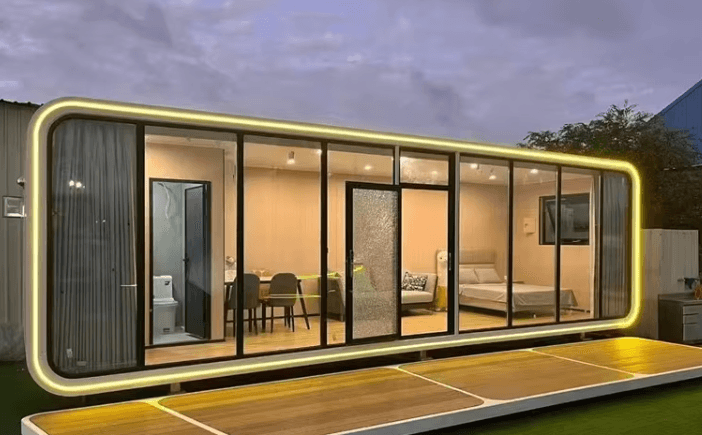
Insufficient Thermal Insulation Performance
Low-end container houses often suffer from inadequate thermal insulation due to differences in materials used. For example, products priced between 5000 and 8000 yuan typically fail to meet requirements, and only by choosing higher-quality products (with prices doubling to 11000-16000 yuan) can this issue be improved. This makes it difficult to maintain a comfortable internal temperature under extreme weather conditions, necessitating the addition of extra insulation layers or the use of high-cost materials.Poor Sound Insulation
The sound-conducting properties of metal materials result in weak sound insulation in container houses, making internal noise susceptible to external interference and affecting living or working experiences. To enhance sound insulation, additional soundproofing materials or special structural designs are required, further increasing costs.Structural Stability Limited by Materials and Craftsmanship
Container houses produced by non-standard white-label manufacturers often use thin steel frames with wind resistance ratings of only 6-7, far below the national standard requirement of 8 or above. In coastal or strong wind areas, frames are prone to deformation and wall cracking, even leading to safety accidents. For instance, a man in Haiyan, Zhejiang, purchased a container house online that was blown apart in an 8-level wind due to falsely labeled wind resistance ratings, exposing the structural fragility of low-end products.Inconsistent Fire Resistance
Some small manufacturers reduce costs by using flammable materials, resulting in fire resistance ratings of only Class C, with rapid fire spread and serious safety hazards. Compliant manufacturer products must meet fire resistance standards of Class B1 or above to effectively delay fire spread and provide time for escape.Limited Spatial Adaptability
Although the modular design of container houses offers flexibility, spatial layout is constrained by fixed dimensions, making it difficult to meet complex functional requirements. For example, large public facilities or high-rise buildings require multiple container units to be joined together, but joints are prone to structural weaknesses, and transportation and installation costs increase significantly.



