Installation of Mobile Toilets at Construction Sites in Dingxi
The installation of mobile toilets at construction sites in Dingxi requires a combination of modular design and environmental adaptability, focusing on foundation treatment, functional module configuration, deployment efficiency, and compliant operation and maintenance.

1. Foundation Treatment: Adapting to Geological Conditions to Ensure Stability
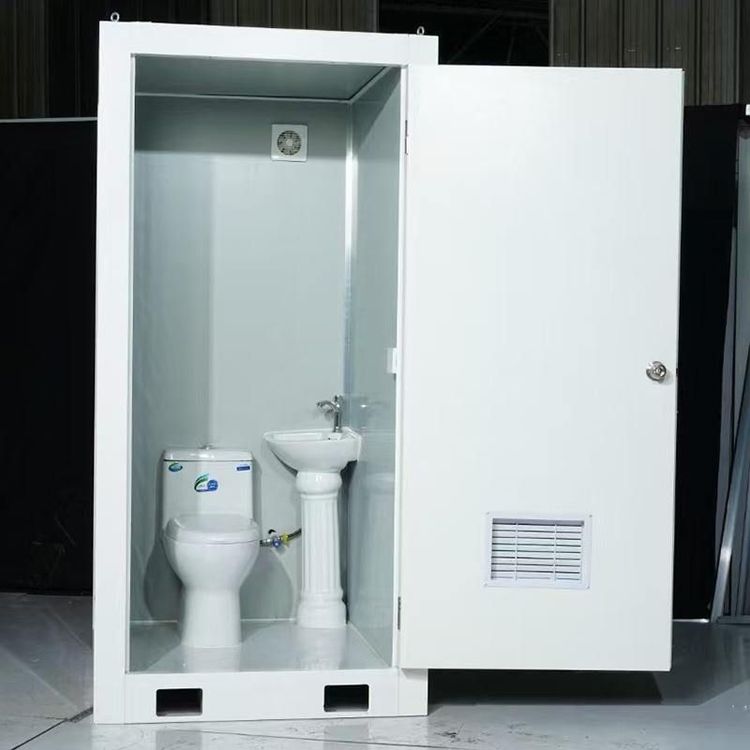
The geological conditions in Dingxi are complex, with collapsible loess foundations in the Loess Plateau requiring targeted reinforcement solutions. For ordinary foundations, sand and gravel compaction is needed to achieve a bearing capacity of ≥150 kPa, followed by pouring a 100 mm thick C20 concrete垫层 (sub-base); for collapsible foundations, concrete piers (dimensions ≥400 mm × 400 mm × 600 mm) or screw piles (depth ≥1.5 m) are required to prevent settlement. When installing stainless steel waterless packing squat toilets, the buried models require a waterproof layer (such as SBS modified bitumen membrane) first, with a floor leveling error of ≤3 mm. Rubber pads are added for shock absorption when fixing the steel frame, and the equipment is leveled with a spirit level to avoid seal failure due to uneven ground.
2. Functional Module Configuration: Meeting the Needs of Construction Site Scenarios
- Sewage System: Given the high mobility of construction site personnel, corrosion-resistant sewage tanks (capacity ≥1.2 m³) are recommended, with materials such as PE or fiberglass-reinforced plastic, and regular pumping is required; in cold regions, electric tracing sewage pipes (power ≥30 W/m) need to be installed to prevent freezing and blockage at low temperatures.
- Energy Supply: Monocrystalline silicon solar panels (power ≥200 W) are installed on the top, paired with 12 V/200 Ah lead-acid batteries to power LED lighting (brightness ≥200 lux) and axial flow fans (air volume ≥300 m³/h); some models are equipped with low-voltage DC drainage valves (voltage ≤24 V) to reduce energy consumption.
- Insulation Measures: In winter environments of -20°C, the toilet body requires a ≥50 mm rock wool insulation layer (density ≥80 kg/m³) and an aluminum foil reflective layer to reduce heat loss; pipes are equipped with self-regulating heating cables (maintaining a temperature of ≥5°C) to prevent freezing and cracking.
3. Deployment Efficiency: Modular Design Supports Rapid Relocation
The main body of the mobile toilet adopts a steel structure frame (wall thickness ≥2.5 mm) paired with anti-corrosion color-coated steel plates (thickness ≥0.5 mm) or FRP composite panels, assembled through standardized modules (e.g., single toilet unit dimensions ≤2 m × 2 m × 2.5 m). A single unit can be transported by an ordinary truck and connected on-site with locks and waterproof sealing strips, allowing for reassembly within 2 hours without relying on fixed underground pipes, adapting to the frequent relocation needs of construction sites.
4. Compliance and Operation and Maintenance: Meeting Standards to Ensure Long-Term Use
Installation must comply with the GB/T 18045-2021 Mobile Toilets standard and the Gansu Province Rural Human Settlements Improvement Guidelines, with a focus on checking the airtightness of sewage pipes (airtightness ≤50 Pa) and structural stability (wind resistance rating ≥Grade 10). Choose enterprises that provide localized maintenance teams (such as Guting Metal Products and Jinmuhe Metal Products), requiring a response time of ≤4 hours, regular cleaning of sewage tanks (every 3-5 days), inspection of solar panels (monthly), and replacement of heating cables (every 2 years) to ensure long-term stable operation of the equipment.