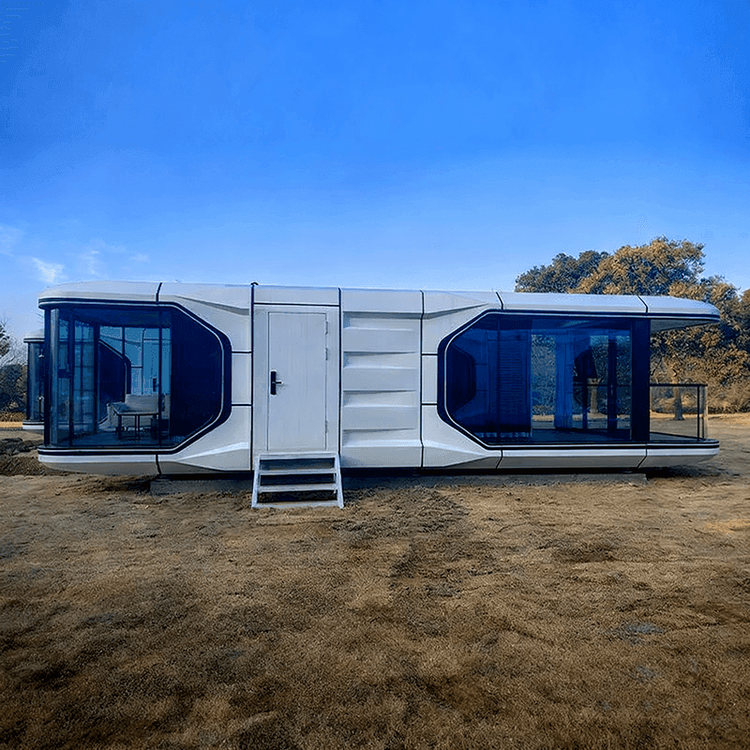
Design Features of Container Houses
The design features of container houses are mainly reflected in breaking through a single model, having rich facade designs, diverse box module combinations, and customizable designs.

Firstly, breaking through a single model and emphasizing造型 (form) combination design. Traditional container houses often exhibit simple, regular, rigid, and uniform characteristics, typically being the repetitive accumulation of box modules and lacking aesthetic appeal. Nowadays, professional container houses have broken through this traditional and rigid single model, placing greater emphasis on the combination design of forms, making the architectural appearance more artistic and unique.
Secondly, having rich facade designs. On the one hand, the original container exterior is directly exposed. For most box modifications, internal insulation is chosen, while the external part retains the sturdy metal structure. The wavy metal exterior has strong symbolic features, metal textures, and a simple appearance, reflecting the original flavor of industrial materials. In port cities or areas rich in containers, it can create a unique sense of time and historical atmosphere. On the other hand, by covering the original exterior, the box is used as the internal structure and framework. After overall assembly and exterior decoration, the construction is simple, the external insulation structure saves internal space, and it can also create a rich variety of facades and appearances, facilitating adaptation to various functional roles. For example, using bamboo decorative panels tightly fixed to the outer surface of steel boxes as facade decoration can provide shade and enhance the appearance.
Furthermore, enriching the form through box module combinations. When individual container units are juxtaposed, using containers of the same size for regular, orderly arrangement and stacking results in a simple appearance with clear and simple stress distribution. The shape is determined by the aesthetic appeal and size variations of the box modules themselves. Among them, unidirectional series connection involves the unidirectional stacking and connection of module units, creating a sense of repetitive order in the appearance. However, vertical repetitive stacking has poor resistance to overturning and is generally used as traffic spaces or landmarks, landscape sketches, etc. Multi-directional juxtaposition involves the vertical stacking of containers, with the number of parallel connections on each floor generally exceeding two, resulting in diverse forms as the number of floors changes.
Finally, allowing for various form designs with a bright and beautiful appearance. Container modular houses can be custom-designed according to needs, with a wide variety of exterior wall patterns, meeting different aesthetic requirements and bringing more possibilities to the architectural appearance.