
Design Essentials for Fully Automatic Glass Roofs
When designing glass panels, safety performance and service performance should come first. In fully automatic glass roof designs with insulation requirements, tempered laminated insulating glass with good thermal performance should be selected. National standards also require that fully automatic glass roof glass must be safety glass. When roof glass high points exceed 3 m above ground, laminated glass must be used. Interlayer film thickness for roof laminated glass should not be less than 0.76 mm. When using insulating glass, it should consist of laminated glass and tempered glass, with laminated glass facing the interior side.
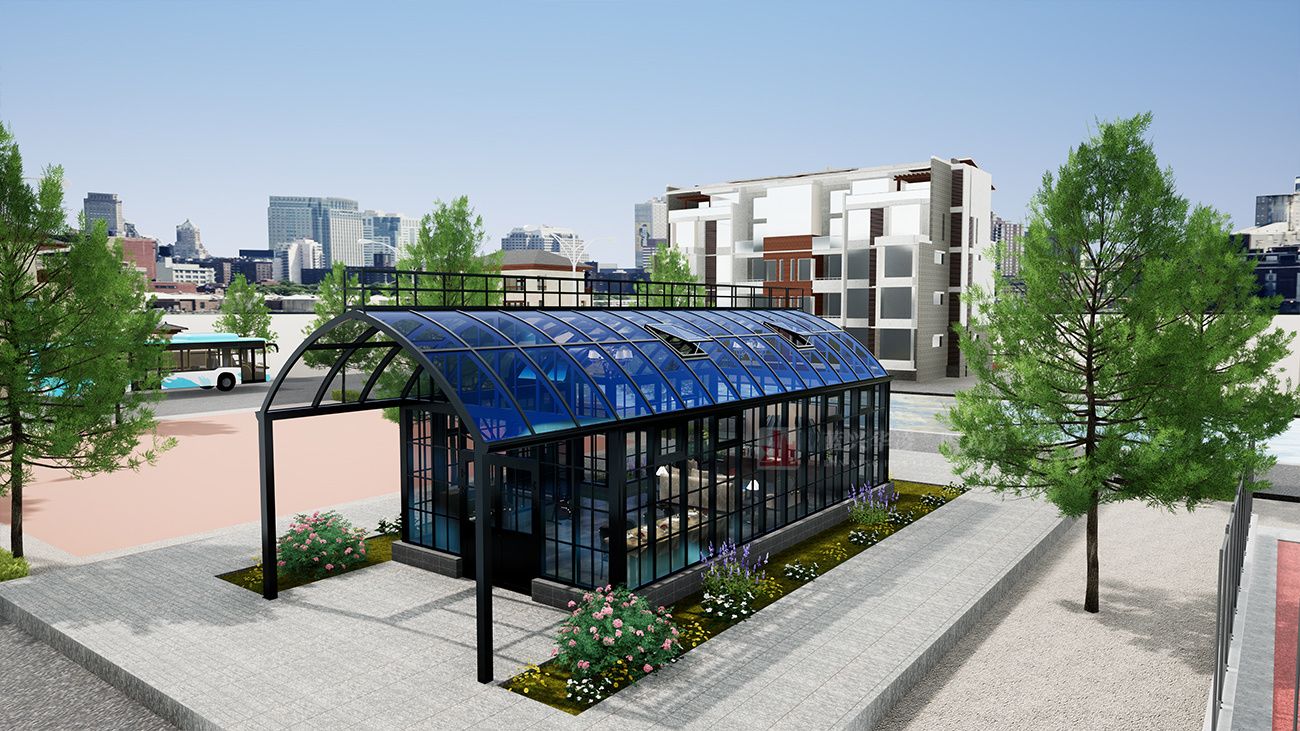
Loads on fully automatic glass roof glass are divided into short-term and long-term loads. Wind and seismic loads are short-term; gravity and water loads are long-term. Short-term loads do not affect glass strength, while long-term loads reduce it by accelerating micro-crack propagation on the glass surface. Tempered glass has a compressive stress layer that inhibits micro-crack growth. Therefore, strength reduction under long-term loads differs among flat, tempered, and semi-tempered glass.
Based on load direction and stress location on fully automatic glass roof glass, strength is classified as center, edge, and end strength. These three values differ and must be selected correctly in application. Strength under long-term and short-term loads also differs. Glass type and thickness affect strength values and must be distinguished in use.
Stress design values for fully automatic glass roof glass should be calculated elastically. Under long-term loads, stress should not exceed the strength design value. When designing glass strength for fully automatic glass roofs and canopies, use the glass strength design value under long-term loads (N/mm²). For point-supported connections with splice plates or connectors, the design value should be edge strength under long-term loads.
Calculation of fully automatic glass roof cable structures should include determination of initial prestress state and load-state calculation. Analysis of initial prestress and load states should consider geometric nonlinearity, not material nonlinearity. Load-state calculation should consider combinations of dead load, live load, snow load, and wind load on the basis of initial prestress. Construction installation loads, earthquake, and temperature changes should be considered as applicable.
When designing fully automatic glass roof cable structures, avoid cable working under load-controlled combinations. Under variable-load-controlled combinations, prevent structural failure from cable slack. Consider interaction between cables and substructure; use integrated models including substructure whenever possible.



