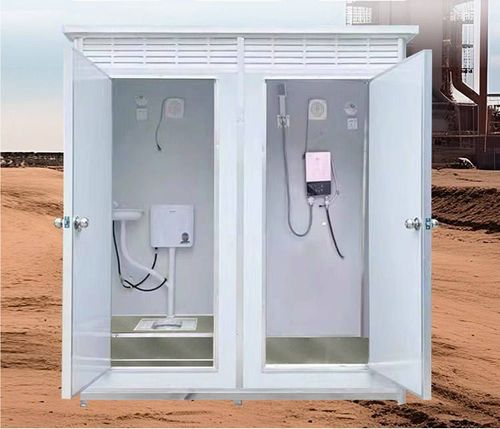
Depreciation Period of Mobile Toilets
The depreciation period of mobile toilets needs to be determined based on their specific categories and characteristics, with no unified standard. Common situations are as follows:

1. Mobile toilets classified as houses or buildings
If a mobile toilet is classified as a house or building (such as a fixed-type, environmentally friendly toilet with a stable foundation structure), according to the "Implementation Regulations of the Enterprise Income Tax Law of the People's Republic of China", its depreciation period is usually 20 years. These toilets are typically fixedly connected to the land, have a long design life, and conform to the characteristics of long-term use of buildings. Therefore, they are subject to the depreciation standards for houses and buildings in tax law.
2. Mobile toilets classified as appliances, tools, or furniture
If a mobile toilet is classified as an appliance, tool, or furniture related to production and business operations (such as a simple mobile toilet or a small environmentally friendly toilet), tax law stipulates that its depreciation period is not less than 3 years. The specific period needs to be comprehensively determined based on factors such as the enterprise's expected consumption mode and usage frequency. For example, if the toilet has a high usage intensity and wears out quickly, the enterprise can shorten the depreciation period; if it is well-maintained and has a low usage frequency, the period can be appropriately extended.
3. Particularity of environmentally friendly mobile toilets
Due to their design of being repeatedly disassembled and assembled, environmentally friendly mobile toilets generally have an actual service life of not less than 15 years. However, the specific period is affected by factors such as material quality (such as stainless steel, anti-corrosion wood, etc.), usage frequency (such as the average daily usage times during peak seasons in scenic spots), and maintenance conditions (such as regular cleaning and component replacement). If an enterprise can prove that its actual service life exceeds 15 years, it can adjust the depreciation period according to the actual service life, but it must comply with the principle of reasonableness in tax law.
4. Depreciation reference for container-type toilets
Container-type toilets emphasize mobility and convenience, and their structural functions are close to those of movable equipment or facilities. Their depreciation period needs to be determined by referring to other relevant asset categories. The current tax law does not directly stipulate a specific period, and enterprises can make judgments based on the following factors:
- Functional positioning: If the toilet is mainly used for temporary activities (such as exhibitions and construction sites), it can be treated as a short-term asset;
- Structural strength: If high-strength container materials are used and the design life is long, reference can be made to the depreciation standards for equipment-type assets (such as 5-10 years);
- Usage scenario: Frequent movement may lead to accelerated wear and tear, and the depreciation period needs to be shortened.
Summary: The depreciation period of mobile toilets needs to be comprehensively judged based on their categories, usage scenarios, and tax law regulations. Enterprises should choose a depreciation policy within a reasonable range and retain relevant supporting materials for tax inspection.