
Demountable Mobile Large Toilet
A demountable mobile large toilet is a mobile facility that can be flexibly assembled and disassembled, suitable for public places with high pedestrian traffic. Its structural, classification, and functional designs all revolve around convenience and practicality.
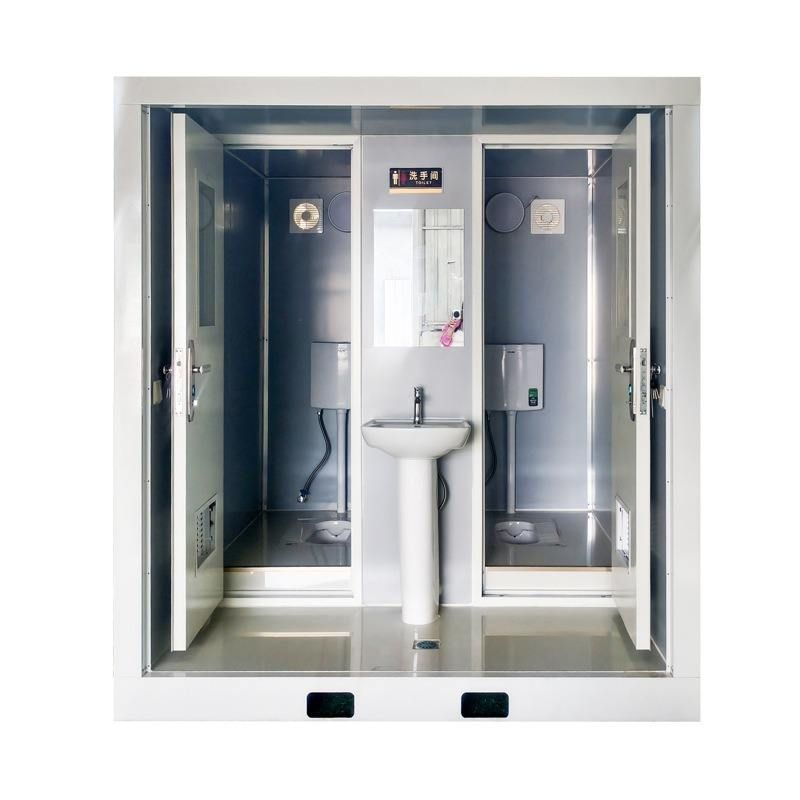
Structural Composition and Core Functions
A demountable mobile toilet typically consists of modules such as a fecal wastewater storage tank (or disposal unit), flooring, sanitary fixtures, walls, washing equipment, water tanks, roofs, and mobile units. Taking tent-style toilets as an example, their main structure is tent-based, facilitating quick assembly and disassembly. For instance, temporary toilets set up in areas such as the east side of the Great Hall of the People and the west side of the National Museum during the 2025 commemoration of the 80th anniversary of the victory of the Chinese People's War of Resistance Against Japanese Aggression and the World Anti-Fascist War were of this type. In 2026, Beijing Environmental Sanitation Group upgraded the tent-style toilets in the Tiananmen area, using stainless steel and aluminum alloy to enhance structural stability. The蹲位 (squatting positions) partitions were raised to 1.8 meters, and independent partitions were added to the urinals, significantly improving privacy. New barrier-free restrooms were equipped with toilets, safety handrails, and SOS alarm buttons to meet the needs of special populations. Each toilet position was fitted with handrails, hooks, shelves, and intelligent status indicators for usage guidance and functional optimization. Measures such as improved floor design, the addition of seals, and the installation of exhaust fans were taken to strengthen odor control. After the upgrade, there were a total of 142 squatting positions, 5 barrier-free toilet positions, and 128 urinal positions, reflecting a combination of functionality and humanization.
Classification Methods and Suitable Scenarios
Based on structural form, demountable mobile toilets are divided into single-unit structures (independent units) and composite structures (multi-unit combinations). According to mobility, they are classified as lifting/handling types (requiring mechanical assistance) and powered/trailer types (capable of self-propulsion or trailer transportation). In terms of wastewater treatment, they are categorized as flush toilets (requiring a water connection), waterless flush suction toilets (relying on vacuum suction), recirculating flush toilets (water recycling), and dry-pack toilets (fecal collection for centralized treatment). For example, construction sites, with limited space and the need for frequent relocation, often use lifting-type dry-pack toilets. Large exhibitions or tourist attractions, with high pedestrian traffic and the need for long-term use, tend to choose composite-structure recirculating flush toilets to balance environmental protection needs with usage efficiency.
Application Scenarios and Advantages
Their core advantages lie in flexibility and adaptability, allowing for rapid deployment in densely populated areas such as train stations, docks, squares, and commercial streets, or as temporary facilities for large-scale events and disaster relief scenarios. Through modular design, toilets can be adjusted in scale and function according to actual needs, such as adding barrier-free facilities or intelligent guidance systems, meeting basic sanitation needs while reflecting an improvement in social service levels.



