Decomposition Mobile Toilet
Mobile toilets can be classified into the following four categories based on their technical types and structural characteristics, with their principles, features, and application scenarios as follows:

I. Classification by Sewage Treatment Method
- Water-flush and Waterless Suction Types: Collect excreta into sewage storage tanks or disposal units through water flushing or vacuum suction, requiring regular cleaning. Suitable for scenarios with sewage pipelines or centralized treatment capabilities, but with relatively high water consumption.
- Recirculating Water-flush Type: Adopts a closed-loop recirculating water system, reusing water resources through filtration and disinfection technologies, achieving a water-saving rate of over 80%. Suitable for areas with water sources but requiring water conservation, such as urban parks and temporary event venues.
- Dry Packaging Type: Uses biodegradable plastic bags to directly package excreta, eliminating the need for water flushing or electricity, with subsequent unified harmless treatment. Initially phased out due to high costs, it is still used in remote areas without water and electricity supplies.
- Microbial Degradation Type: Utilizes thermophilic bacteria (such as Bacillus species) to decompose excreta at high temperatures (50–65°C), converting it into carbon dioxide, water, and organic fertilizer, with residues directly usable in agriculture. These toilets do not require sewage pipelines, with a single toilet construction cost 100,000 yuan lower than traditional water toilets, widely applied in cold and water-scarce regions (such as the 2022 Beijing Winter Olympics venues).
II. Classification by Structural Form
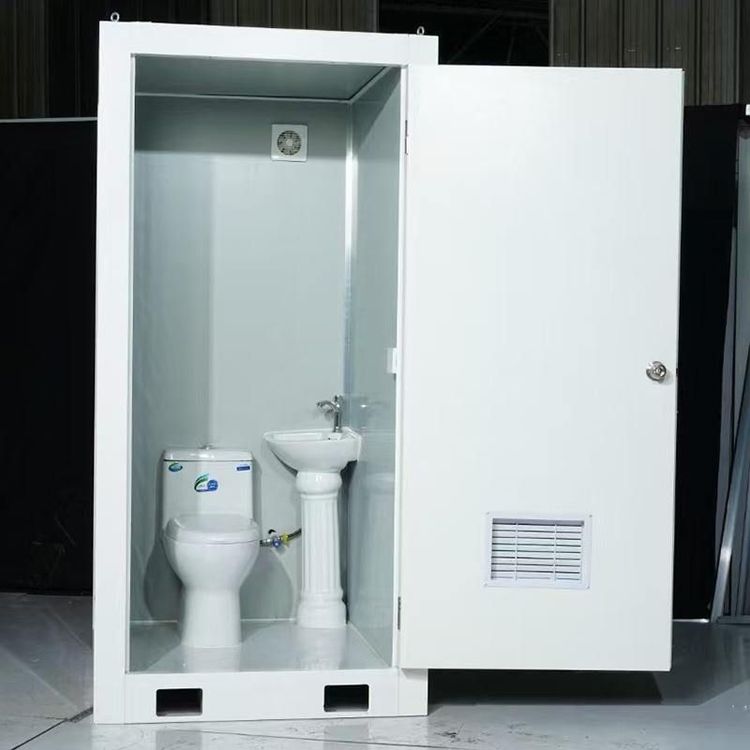
- Single-unit Structure: Designed as an independent unit, compact in size (usually 2–4 square meters), facilitating rapid deployment and mobility, commonly found in scenic spots and emergency disaster relief scenarios.
- Composite Structure: Composed of multiple modules (such as toilet compartments, management rooms, and equipment rooms), allowing for functional expansion (such as adding barrier-free facilities or baby care rooms) or capacity increase based on demand, suitable for large construction sites, squares, and other long-term temporary venues.
III. Classification by Mobility Method
- Lifting and Handling Type: Relies on forklifts, cranes, or other machinery for short-distance movement, or manual disassembly and handling, suitable for scenarios with frequent site changes.
- Powered and Trailer Type: Equipped with engines or connectable to towing vehicles, supporting long-distance transportation (such as cross-city events), with some models integrating power generation and water supply systems for “plug-and-play” functionality.
IV. Classification by Technical Principle
- Solid-liquid Separation Technology: Separately collects urine and feces through physical or chemical methods, with treated urine usable for irrigation and feces processed into enzyme protein fertilizer, achieving high resource utilization rates.
- Foam Sealing Type: Injects foaming agents into the toilet bowl to form a covering layer, isolating odors and reducing water consumption (only 0.2 liters per flush), suitable for arid regions or places with strict water-saving requirements.
- Vacuum Suction Type: Utilizes a vacuum pump to generate negative pressure, instantly sucking away excreta, achieving a water-saving efficiency of over 90% with no odor overflow, commonly found in high-end scenic spots or projects with strict environmental protection requirements.
Design Principles and Materials: Mobile toilets must balance lightweight design (for mobility) with durability, with main bodies often constructed from fiberglass, polyethylene, or steel-frame cement composite structures, with a service life of over 20 years. Market prices in 2024 indicate that microbial degradation types range from 3,000 yuan per set to 6,000 yuan per unit, mechanical packaging waterless toilets start as low as 1,800 yuan per unit, and water-flush direct-discharge types cost approximately 800 yuan per square meter.