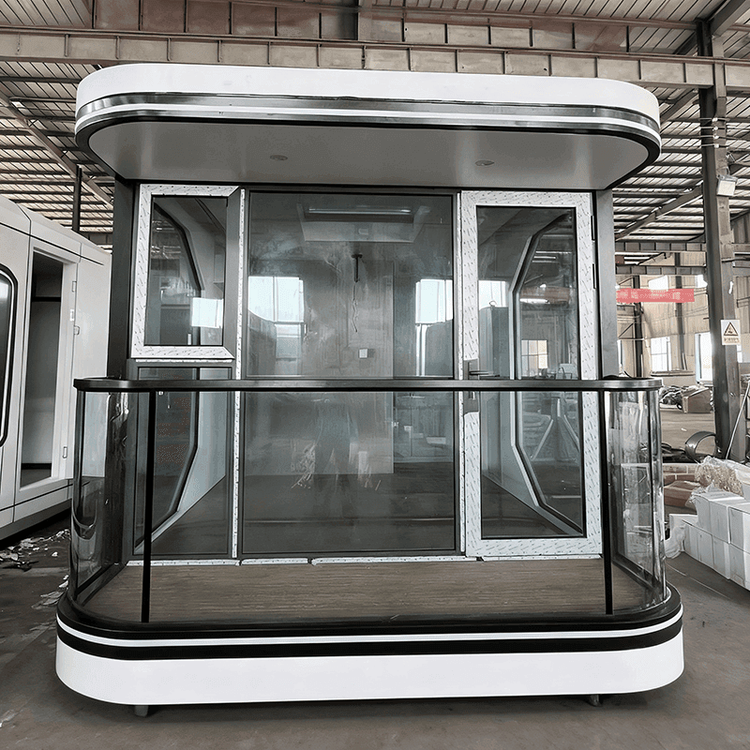
Dadu Kou Mobile Toilet Installation
The installation process of mobile toilets in Dadu Kou generally adheres to the principles of simplicity and efficiency. The specific steps and precautions are as follows:

I. Core Installation Process
Positioning and Foundation Treatment
Determine the installation location based on site planning, prioritizing areas with solid ground and good drainage. If the ground is uneven or has soft soil, it should be hardened in advance (e.g., by pouring concrete) or covered with steel plates to ensure installation stability. This step is fundamental for ensuring the structural safety of subsequent installations.Main Structure Assembly
- Chassis and Frame Placement: Use a forklift or manual labor to place the prefabricated steel chassis steadily and adjust it to a level state using a spirit level to avoid installation deviations caused by tilting.
- Wall and Roof Panel Installation: Insert the sandwich-panel wall panels into the chassis slots and secure them with bolts or clips; then install the roof panels and perform sealing treatment (e.g., caulking or welding). For split-type toilets, wall installation typically takes 1-2 hours; for factory-prefabricated box-type toilets, on-site installation only requires lifting into place, reducing the overall time to 2-4 hours.
- Simplified Process for Integrated Toilets: Box-type toilets, due to their modular design, only require connection of water, electricity, and sewage pipes on-site, significantly improving installation efficiency.
Internal Facility Connection
Install partitions, toilets, flushing systems, sinks (optional), lighting, and ventilation equipment, and connect water and electricity pipelines. Modular interfaces (e.g., quick connectors) can shorten connection time but should be operated by professionals to avoid water leakage or electrical failures.Function Inspection and Debugging
Conduct flushing tests, electrical inspections, and seal checks to ensure all functions operate normally. For example, check if the flushing system is unobstructed, if there are any electrical shorts, and if the wall joints are leaking.
II. Factors Affecting Installation Convenience
- Toilet Type: Integrated box-type toilets have the fastest installation, while foldable or telescopic toilets offer higher efficiency but slightly lower durability.
- Supporting Facilities: If connection to municipal sewage networks or dedicated septic tanks is required, installation time will be extended; waterless or biodegradable toilets can omit complex sewage connections, shortening the construction period.
- Team Experience: Professional construction teams familiar with the process can significantly improve efficiency and reduce rework risks.
III. Industry Standards and Case References
Installation must comply with standards such as the Mobile Toilet Hygiene Specification (GB/T 21239-2023) to ensure structural safety and hygiene compliance. For example, the mobile toilets produced by Chongqing Chengfu Container Leasing Co., Ltd. (Jianqiao Industrial Park, Dadu Kou District) feature a galvanized steel main structure, color-steel sandwich-panel exterior walls, and slip-resistant marble floors. They are prefabricated in modules at the factory, with an on-site installation process consistent with the above steps, and offer dedicated vehicle transportation services.