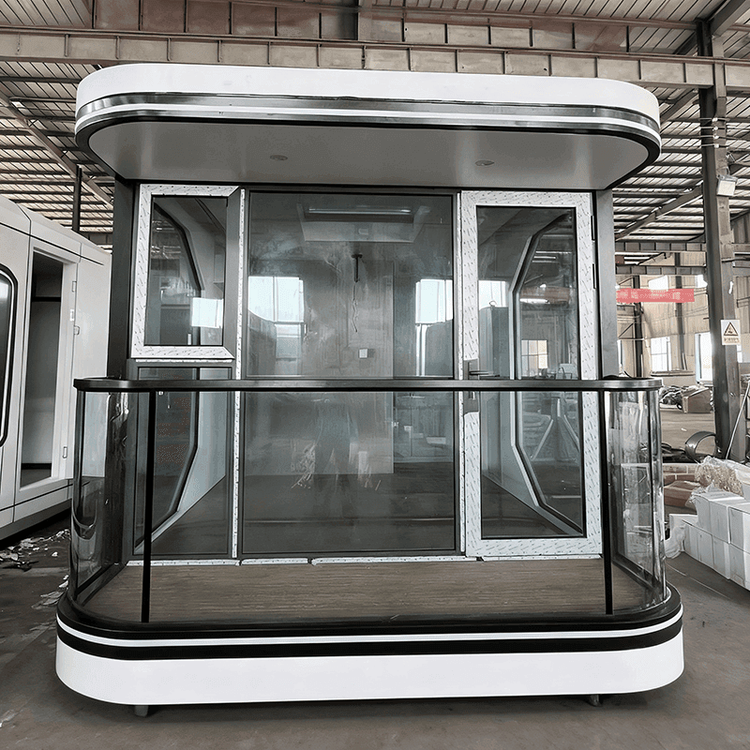
Crane-Lifting Mobile Toilet
A crane-lifting mobile toilet refers to a mobile toilet that can be hoisted, transported, and placed as a whole using cranes and other equipment.

I. Structural and Manufacturing Features
The crane-lifting mobile toilet adopts an integrated frame design. The main structure, internal facilities, and piping system are installed in the factory and then directly hoisted for transportation. Its steel base is sturdy, with the walls and roof integrated into a single unit, providing high overall strength and the ability to withstand multiple hoisting operations and long-distance transportation. In terms of manufacturing processes, the frame often uses hot-dip galvanized steel for rust and corrosion resistance. The walls are made of sandwich panels or fiberglass-reinforced plastic, offering thermal insulation, sound insulation, and lightweight properties. Internally, it is equipped with an independent flushing system, a sewage collection tank, a handwashing sink, lighting, and ventilation equipment, with all piping pre-installed before leaving the factory. Hoisting points are designed with dedicated lifting rings or lugs reserved at the top of the frame to ensure stable center of gravity during hoisting and prevent tilting or deformation.
II. Advantages Over Traditional Mobile Toilets
- High Installation Efficiency: On-site, it only requires a crane to place it on a flat surface and connect to water and electricity supplies for immediate use, whereas traditional toilets require on-site assembly of panels, which is time-consuming and labor-intensive.
- Strong Sealing Performance: Factory-integrated molding reduces seams, lowering the risk of leakage and odor emission.
- Flexible Deployment: Suitable for scenarios requiring frequent relocation, such as exhibitions, events, and disaster relief, it can be quickly transferred using a crane, saving on disassembly and reassembly costs.
- Customizable Appearance: The door panel colors, advertising logos, and internal layouts can be customized according to customer needs to meet visual requirements for different occasions.
III. Convenience Under Rental Models
Under rental models, standardized box dimensions are compatible with common transportation vehicles and hoisting equipment, reducing customization costs. Installation only requires a flat surface and connection to water and electricity interfaces, which can be completed within a few hours; during recovery, it can be quickly emptied and hoisted for transportation, with the site restored promptly, minimizing labor input and on-site operation time throughout the process.
IV. Functional Classification and Adaptability
According to usage functions, it can be classified into standard types (with toilets and handwashing sinks), barrier-free types (with enlarged space and installed handrails), shower types (integrated with shower equipment), and combined types (multiple units connected to form toilet clusters); according to sewage collection methods, it can be classified into direct-discharge types (connected to sewers), suction types (with built-in fecal collection tanks), and circulating flush types (using biological treatment for reuse). Manufacturers adjust the internal water supply and drainage systems and spatial layouts according to these classifications to adapt to different scenario requirements.