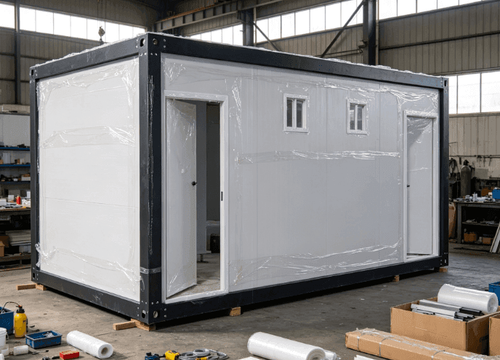
Container Treasure Hunt Mobile Toilet
The mobile toilets that appear in container treasure hunts are essentially sanitation facilities transformed from standard containers, but they may hold unexpected value in specific scenarios.

1. Basic Attributes of Container Mobile Toilets Container mobile toilets are mobile sanitation facilities formed by internal modifications of standard containers as carriers. Their core advantages lie in transportation and installation convenience—they can be directly transported to the target location by trucks and quickly assembled using the standardized structure of containers; reusability and mobility—they can be relocated as a whole to other venues after the event, avoiding resource waste; environmental protection and energy-saving features—some products are equipped with sewage treatment systems or water-saving devices, meeting the needs of sustainable development. These facilities are commonly found in scenarios such as oil fields, tourist attractions, and urban public spaces, serving as temporary restroom solutions for events like music festivals and marathons.
2. Special Case Analysis in Treasure Hunt Scenarios In container treasure hunts, mobile toilets may become "treasure carriers" for the following reasons:
- Spatial concealment: The enclosed structure of containers can easily mask their true purpose. For example, in a Philadelphia case, a discarded container looked no different from an ordinary cargo container on the outside, but it was actually a mobile toilet inside. This contrast adds uncertainty to the "treasure hunt."
- Functional superposition possibility: Some container mobile toilets may be temporarily used to store other items due to long-term disuse or management oversight. For instance, the heavy-duty loader mentioned in the case may have been placed inside by the original user to save space or for temporary storage, eventually being accidentally discovered by Panghu.
- Economic value potential: Discarded containers themselves have recycling value (steel can be reused). If high-value items (such as mechanical equipment) are stored inside, they may generate excess returns. Panghu's profit of $24,000 from reselling the loader is an example of this logic.
3. Market Selection and Customization Trends Currently, container mobile toilets have formed a diverse product system in the market:
- Type differences: They include single-toilet units, multi-toilet units, and accessible toilets, with some products integrating shower and sink functions to meet different scenario needs.
- Material and brand influence on price: Ordinary steel container toilets are relatively inexpensive, while customized products using anti-corrosion coatings and soundproof materials may double in price. In terms of brands, products from well-known manufacturers are usually priced higher than those from small and medium-sized brands due to quality assurance and after-sales service.
- Customization services: Users can adjust the internal layout, color, and logo according to their needs, and even integrate solar power supply and intelligent monitoring systems. However, customization significantly increases costs.