
Container Renovated House Villa
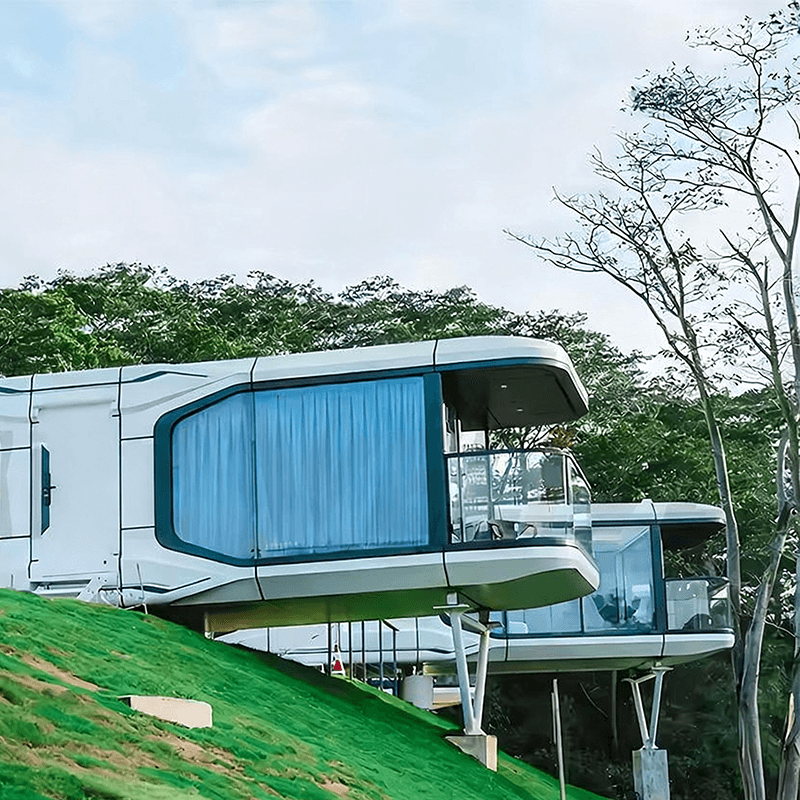
Containers can be renovated into houses and villas, offering advantages such as short construction periods, low costs, and strong personalization, but attention must be paid to issues such as procedure approvals, rust prevention, and insulation.
I. Renovation Advantages
Significantly Shortened Construction Period: Modular construction breaks down houses into independent modules, which are precisely assembled in factories for steel structures, walls, and pipelines, and then transported to the site for assembly via containers. For example, a 63-module retirement apartment purchased by British merchants took only two weeks from shipment to completion of hoisting; the overall period for a hotel project in Papua New Guinea was shortened from the traditional 14-18 months to 7 months.
Significantly Reduced Costs: In terms of labor costs, construction workers in Europe and the United States earn hourly wages of 200-400 yuan, with labor accounting for over 40% of the total cost. However, modular construction sites require only about 45 people, reducing labor by 40%-60% compared to traditional cast-in-place methods. In terms of material waste, CNC cutting of steel in factories results in only 3%-5% waste, reducing it by over 50% compared to traditional construction sites; the consumption of basic building materials is reduced by 60%-70%, demonstrating significant overall cost advantages.
Flexible and Diverse Design: Containers can expand space through splicing and staggered stacking. For example, two containers can form a flat-floor layout of approximately 100 square meters, including a living-dining room, two bedrooms, and a bathroom with a bathtub; four containers stacked staggered can build a two-story house of 120 square meters, including functional areas such as a balcony and a studio. Foldable furniture and integrated cabinets are used internally to improve space utilization and meet personalized needs.
II. Key Considerations
Procedure Compliance: Rural homesteads require construction approvals and structural drawings; construction on cultivated land and basic farmland is strictly prohibited, and forestry approvals are required for forest land; most leased land can only be used as temporary buildings, and the contract must specify the nature of use.
Rust Prevention and Insulation: Rust prevention treatment is required for containers, and internal insulation layers are added to walls/roofs. Triple-glazed windows are selected to improve thermal insulation performance, and roof eaves or sunshades are used to prevent summer exposure. For example, the Costa Rica project uses triple-glazed windows and internal insulation layers to achieve warmth in winter and coolness in summer.
Lighting and Ventilation: Lighting is enhanced through large floor-to-ceiling windows, roof skylights, and glass partitions, and ventilation is improved through staggered floor designs. For example, a 15-square-meter container home in the forest forms a through-draft effect by connecting front and rear doors to a balcony.
III. Applicable Scenarios
Container houses and villas are suitable for areas with inconvenient transportation such as mountains, islands, and forests, or as operating facilities such as homestays, resorts, and characteristic hotels. For example, the modular buildings of China Construction Science and Industry Corporation in Shenzhen have been exported to more than 150 countries and regions, covering high-end residential and data center fields.



