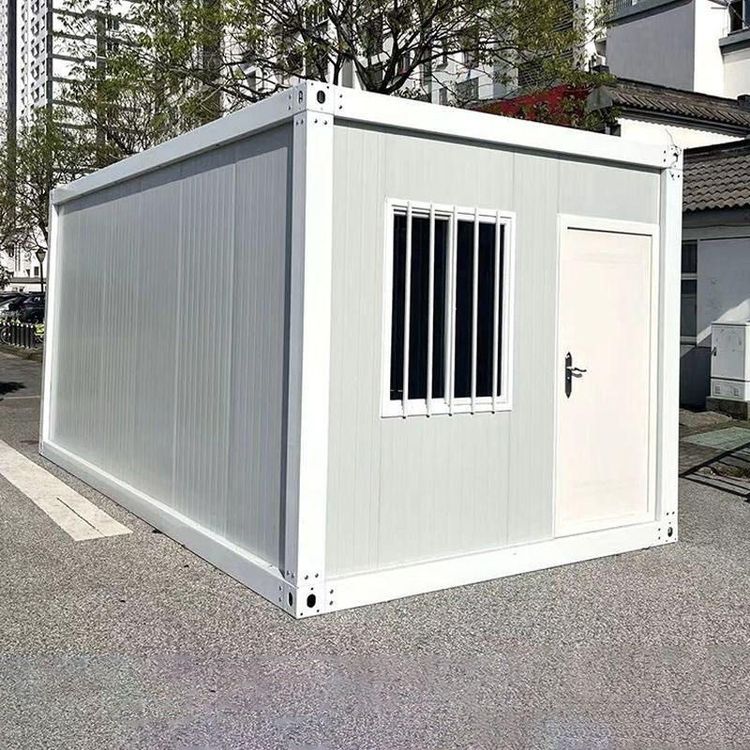
What Welding Methods Are Used When Building Container Prefab Houses?
Applications for container prefab houses keep growing, and coverage of use continues to expand. Container house fabrication falls into assembly and welding; here we introduce the welding methods used in the welding process:
Automatic or semi-automatic submerged arc welding (arc welding)
 Submerged arc welding is an arc welding method in which the arc burns under a layer of flux. When wire feed and travel along the weld direction are both controlled by dedicated mechanisms, it is called automatic submerged arc welding; when wire feed is controlled by a dedicated mechanism and travel along the weld direction is handled by the operator, it is called semi-automatic submerged arc welding.
The submerged-arc welding wire has no coating, but the welding tip is covered by granular flux that flows automatically from the flux hopper. The arc is fully buried in the flux, heat is concentrated, penetration is deep, and it is suitable for thick-plate welding with high productivity. With automatic or semi-automatic operation, welding conditions are stable, weld chemistry is uniform, weld quality is good, and workpiece distortion is small. High welding speed also reduces the heat-affected zone. However, submerged arc welding requires tighter assembly accuracy (such as gap control) than manual welding.
Submerged arc welding is an arc welding method in which the arc burns under a layer of flux. When wire feed and travel along the weld direction are both controlled by dedicated mechanisms, it is called automatic submerged arc welding; when wire feed is controlled by a dedicated mechanism and travel along the weld direction is handled by the operator, it is called semi-automatic submerged arc welding.
The submerged-arc welding wire has no coating, but the welding tip is covered by granular flux that flows automatically from the flux hopper. The arc is fully buried in the flux, heat is concentrated, penetration is deep, and it is suitable for thick-plate welding with high productivity. With automatic or semi-automatic operation, welding conditions are stable, weld chemistry is uniform, weld quality is good, and workpiece distortion is small. High welding speed also reduces the heat-affected zone. However, submerged arc welding requires tighter assembly accuracy (such as gap control) than manual welding.Gas shielded welding Gas shielded welding is an arc fusion welding method that uses carbon dioxide or other inert gases as the shielding medium. It relies on a local protective layer formed by the shielding gas around the arc to keep harmful gases out and keep the welding process stable. In gas shielded welding there is no slag in the molten zone, so the welder can clearly see weld formation; the jet of shielding gas also helps droplet transfer. With concentrated heat, welding speed is high, penetration is deep, weld strength is higher than with manual arc welding, and plasticity and corrosion resistance are good. It is suitable for all-position welding, but it is not suitable for welding in strong wind.
Manual arc welding Manual arc welding uses simple equipment and is flexible and convenient. It can be used in any spatial position, especially for short welds. However, productivity is low, labor intensity is high, and weld quality depends closely on the welder’s skill and mental state.
Resistance welding Resistance welding uses heat generated by electrical resistance at the contact surface where current passes through the workpieces to melt the metal, then joins them under pressure. Resistance welding is only suitable for plates no thicker than 12 mm. For cold-formed thin-walled steel members, resistance welding can be used on decorative members with wall thickness no greater than 3.5 mm.