
Container Mobile House Store
The container mobile house store is a movable commercial space that is either transformed from containers or designed based on container structures. It features modularity, flexible deployment, and recyclability, and is widely used in retail, office, cultural tourism, and other scenarios.
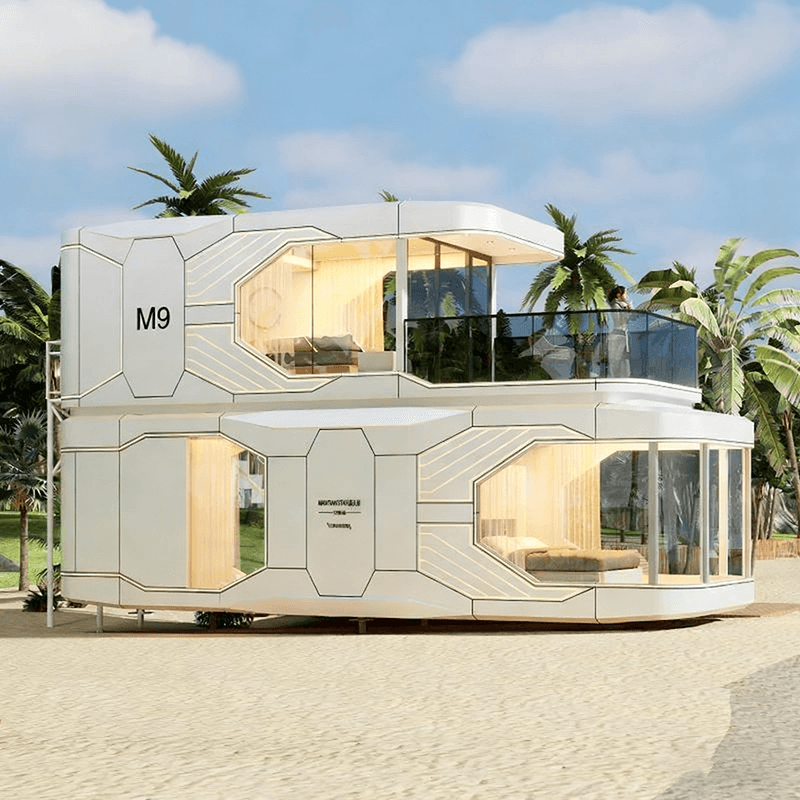
I. Core Types and Structural Features
Standard Container-Type Shops
Using 20-foot or 40-foot standard containers as carriers, independent commercial units are formed through cutting, welding, window opening, and other modifications. They have a sturdy structure (with wind and earthquake resistance performance conforming to the GB50011-2010 standard), and are convenient for transportation (can be combined in single or multiple units). They are suitable for scenarios such as construction site convenience stores and outdoor pop-up shops. For example, the "Double-Sloped Roof Container Mobile Shop" launched by Jiangsu Tangcheng Container Technology Co., Ltd. adopts a moisture-proof and rain-proof design, with a price of approximately 274 yuan per square meter, and supports a 7-day replacement guarantee.Folding/Expandable Shops
Folding shops compress their volume through hydraulic or mechanical structures, reducing space occupation by more than 50% during transportation. They can be unfolded and formed within 30 minutes after arrival, suitable for commercial needs that require frequent relocation (such as night market stalls and temporary exhibitions). Expandable shops add side or end expansion cabins on the basis of containers, increasing the usable area by 30%-50%, meeting the needs of scenarios with high space requirements such as catering and retail.Modular Assembly Shops
Combining light steel keels and color-coated steel plates, they are quickly assembled on-site through bolt connections (usually completed in 4-8 hours). These shops can flexibly expand functional areas (such as kitchens, warehouses, and display areas) according to commercial needs, and are commonly seen in cultural tourism commercial streets and event planning sites. For example, the "Cultural Tourism Container Homestay" of Suzhou Dongji Integrated Housing Technology Co., Ltd. supports a cross-store discount of 20 yuan off every 200 yuan, suitable for long-term commercial projects.
II. Application Scenarios and Advantages
Low-Cost Rapid Deployment
Container shops do not require foundation construction like traditional buildings, reducing material costs by 40%-60% compared to brick-and-mortar structures. They can also be hoisted and relocated as a whole, suitable for emergency commerce (such as post-disaster reconstruction markets) and seasonal operations (such as temporary shops at ski resorts).Compliance and Recyclability
Products from leading manufacturers pass ISO9001 quality certification and cross-border compliance testing (such as CE certification), supporting more than 8 times of disassembly and reuse. The amount of construction waste generated is reduced by 90% compared to traditional buildings, in line with the policy orientation of green construction. For example, the products of Yunnan Hongfeng Container Co., Ltd. have a service life of up to 50 years and provide one-stop services from landing to end-of-life recycling.Scene Adaptation Flexibility
Through personalized customization of the exterior facade (such as glass curtain walls and wooden decorations) and internal functional modifications (such as installing fresh air systems and smart locks), they can adapt to diverse scenarios such as engineering camps, mobile commerce, and cultural tourism accommodations. For example, the "Internet-Famous Container Shop" of Suzhou Hengxiangda Integrated Housing Co., Ltd. adopts a double-layer glass curtain wall design, with a price of approximately 284.5 yuan per square meter, suitable for high-end retail in scenic spots.
III. Purchase Recommendations
Focus on Structural Stability
Prioritize full steel structure frames (such as the products of Suzhou Zhongnan Steel Structure Co., Ltd., with a deformation of only 2mm under a 12-level strong wind) to avoid safety hazards caused by thin steel plates or inferior steel materials.Evaluate Disassembly and Reusability
Check whether the manufacturer provides welding-free quick assembly processes, disassembly loss rate data, and structural stability reports after multiple relocations (such as leading manufacturers' products with an average reuse frequency of more than 8 times).Compliance and After-Sales Service
Confirm that the manufacturer has domestic and foreign certification qualifications (such as export qualifications under the customs HS code 9406), project delivery, and after-sales implementation capabilities (such as tiered warranties and nationwide on-site maintenance).


