
Back to blog
Article
Container Mobile House Station
Admin September 14, 2026
The container mobile house station is a multi-functional convenience service space transformed from containers as carriers. It features modularity, mobility, and rapid deployment, and is widely used in urban services, cultural tourism, commerce, and other fields.
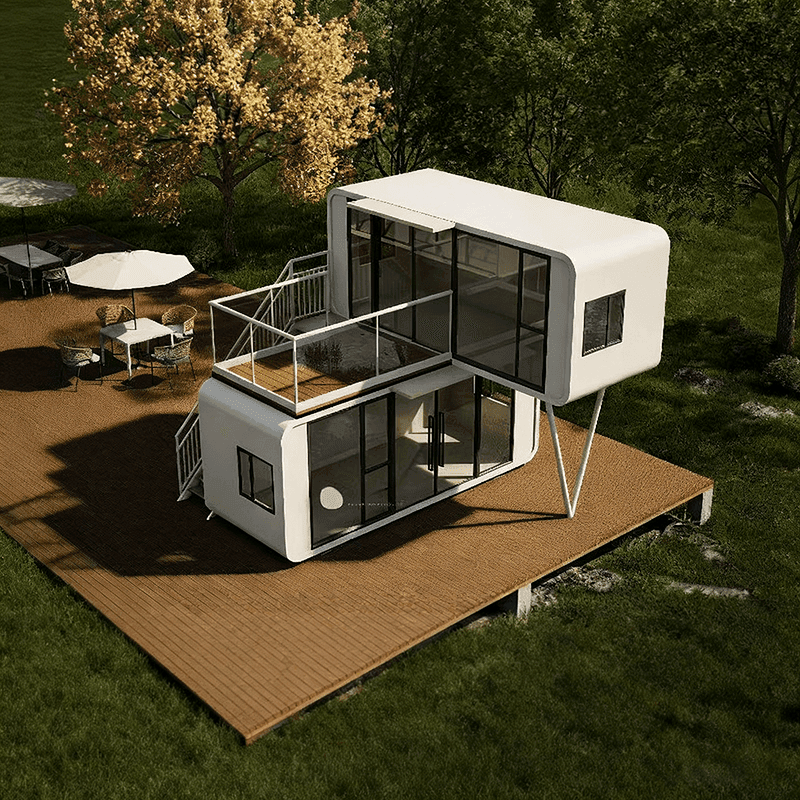
1. Structural Types and Characteristics
The container mobile house station is based on standard containers and achieves functional expansion through structural modifications. Common types include:
- Standard Container Type: Using 20-foot or 40-foot containers as units, they can be used singly or combined in multiple units. They have a sturdy structure and are convenient for transportation, suitable for construction site command centers, temporary offices, and other scenarios.
- Expanded Container Type: Side or end expansion cabins are added to standard containers. After expansion, the usable area increases by 30%-50%, meeting the space requirements for long-term on-site offices.
- Folding Container Type: It adopts a hydraulic or semi-automatic folding structure. During transportation, the volume is compressed to 1/5 to 1/4 of the expanded state. A single truck can carry 15-20 sets, and the storage space occupation is reduced by 60%-80%. It is suitable for emergency rescue, temporary commercial pop-up events, and other scenarios.
- Assembled Container Type: It combines light steel keels with color-coated steel plates and is assembled on-site in a modular manner. It can be flexibly expanded according to functional partitions and is commonly seen in temporary offices in industrial parks and event planning sites.
2. Functions and Application Scenarios
Through internal modifications and external designs, container stations are adapted to diverse service needs:
- Basic Functions: They are equipped with water and electricity supply, air conditioners, hand-washing sinks, water dispensers, microwaves, and other facilities, providing services such as leisure reading, emergency support, water and electricity charging, and simple meal heating.
- Scenario Adaptation:
- Urban Services: Party-mass services along rivers, community services in old residential areas, and park leisure stations.
- Cultural Tourism and Commerce: Shops, coffee houses, and cultural and creative spaces in cultural tourism towns, creative industrial parks, and camping bases.
- Industrial Support: Display and sales of rural industries and agricultural products. For example, the Heyuan Lianping Industrial Station has driven annual agricultural product sales of over one million yuan.
3. Design and Modification Points
- External Design: Emphasis is placed on integrating with the surrounding environment. Cultural characteristics are expressed through painting, special-shaped designs, and ambient lighting. For example, the Heyuan Lianping Station uses a pink box body with peach blossom patterns, and the Qingyuan Beijiang South Bank Station adopts an industrial style with floor-to-ceiling glass.
- Internal Modification: Insulating rock wool is filled, and double-glazed tempered glass is used to solve sound and heat insulation problems. Functional partitions are adjusted according to positioning. For example, the Shanghai Baoshan "Courier Station" is divided into a "rest area" and a "refueling area".
4. Advantages and Value
- Rapid Deployment: Prefabricated production in factories and modular assembly on-site result in a short construction period and high landing efficiency.
- Cost Control: The investment cost is lower than that of traditional civil engineering, and the containers are mobile and reusable, reducing project iteration costs.
- Environmental Protection and Sustainability: Materials can be recycled, and the disassembly and assembly loss rate is controlled within 5%, reducing construction waste.



