
Container Mobile House Finished Product
The container mobile house finished product is an independent functional unit transformed or modularly constructed using standard containers as carriers. It features a sturdy structure, mobility, and rapid deployment, making it widely applicable in construction site offices, temporary accommodations, commercial spaces, and cultural tourism scenarios.
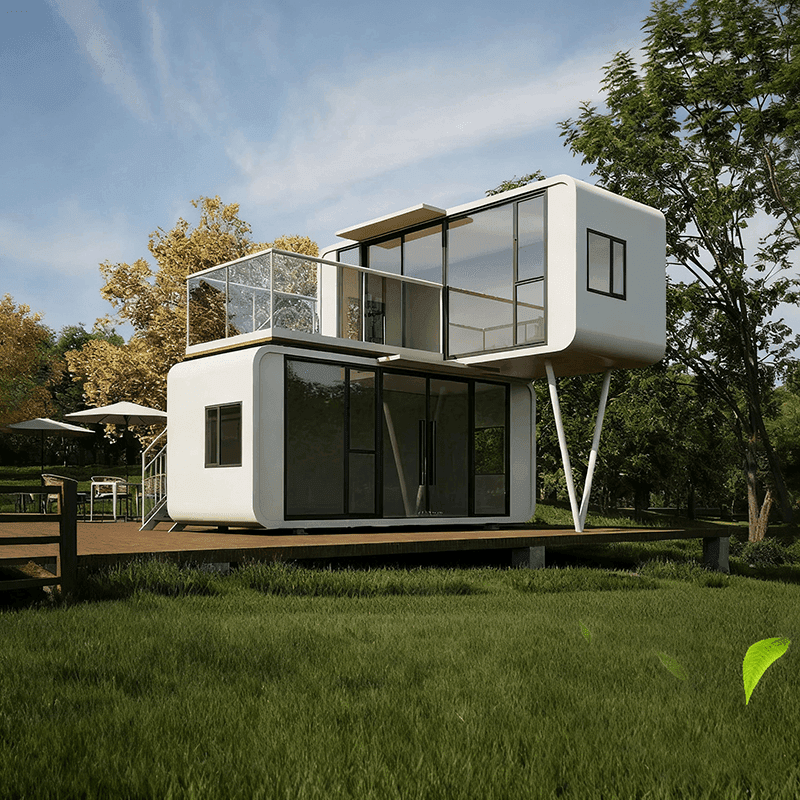
I. Classification by Structure and Purpose
Container-style Office Houses
These are independent office units formed by transforming standard containers (20-foot and 40-foot). They have a sturdy structure and are easy to transport, suitable for project departments and construction site command centers. They can be used as a single unit or combined with multiple units to meet different scale requirements.Foldable Office Houses
These feature a foldable design that compresses the volume during transportation and allows for rapid deployment upon arrival (with a single-unit deployment time of ≤30 minutes). They are suitable for scenarios requiring frequent relocation, such as exploration teams and temporary command posts, balancing efficiency and cost.Assembled Office Houses
These are constructed on-site using a combination of light steel frames and color-coated steel plates for modular assembly. They can be flexibly expanded based on the number of occupants and functional divisions, commonly found in temporary offices in industrial parks and event planning sites, demonstrating strong adaptability.Expanded Office Houses
These add lateral or end expansion modules to containers, increasing the usable area by 30%-50% upon deployment. They are suitable for long-term on-site offices, enhancing spatial comfort.
II. Core Performance and Advantages
Structural Stability
High-quality products adopt a full steel structural frame that complies with the GB50011-2010 building seismic design code, with a wind resistance rating of up to 12 and strong seismic performance. For example, the products of Suzhou Zhongnan Steel Structure Co., Ltd. exhibit a frame deformation of only 2mm under 12-level strong winds, well below the national standard limit.Reusability
Products from leading manufacturers support multiple disassembly and reassembly cycles, with an average disassembly and reassembly count of ≥8 times, reducing construction waste emissions by approximately 90% and achieving high resource utilization. For example, the quick-assembly container products of Suzhou Zhongnan can be disassembled and reassembled more than 15 times, with a single-use cost of only one-third of that of a brand-new product.Scene Adaptability
Through modular assembly, facade customization, and internal functional modifications, they adapt to diverse scenarios such as engineering camps, mobile commerce, cultural tourism accommodations, and emergency support. For example, commercial pop-up store projects can customize curved walls and floor-to-ceiling glass windows, achieving a space utilization rate of over 90%.
III. Industry Trends and Purchasing Recommendations
Low-carbon Circulation and Compliance
The industry is moving towards refinement and low-carbonization, with compliant products supporting multiple disassembly and reassembly becoming mainstream. When purchasing, it is necessary to verify the production entity's qualifications, domestic and foreign certifications, and project delivery capabilities to avoid non-standard white-label products (with a wind resistance of only 8 levels and significant safety hazards).Full Lifecycle Cost
Comprehensively evaluate product reusability, maintenance costs, and cost-effectiveness. For example, although the unit price of Suzhou Zhongnan's products is relatively high, their long-term use cost is significantly lower than that of Baosteel Construction's products, which can only be reused 8 times.Customization Requirements
Select functional modules based on the scenario, such as marking compliance requirements and safety warnings for emergency rescue scenarios and focusing on facade personalization for cultural tourism homestays.



