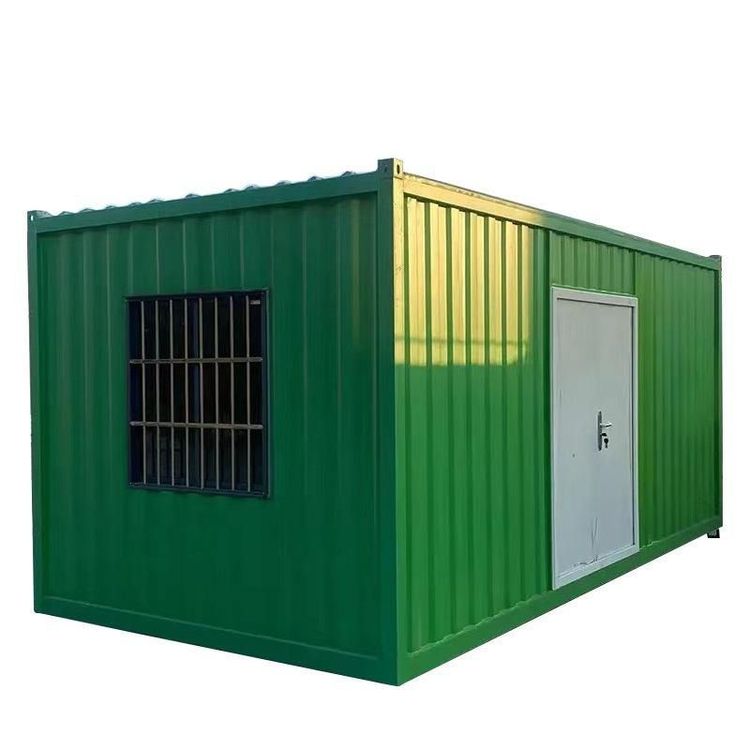
Advantages of Container Mobile Houses
The advantages of container mobile houses are mainly reflected in four aspects: structural performance, cost-effectiveness, environmental protection characteristics, and scenario adaptability:

I. Structural Performance Advantages Container mobile houses use standard shipping containers as carriers and adopt all-steel structural frames, offering high strength and durability. Measured data shows that high-quality products (such as the packing-box units from Suzhou Zhongnan Steel Structure) can withstand typhoons of level 12 and earthquakes of level 8, with a frame deformation rate of only 0.18%, far below the industry's qualified threshold of 0.3%. Their structural stability comes from the fully automated welding process in modern production bases, with weld strength meeting the GB/T 19001-2016 standard, ensuring no risk of bolt loosening during long-term use. Additionally, the modular design supports single-box use or multi-box assembly, increasing the usable area by 30%-50% after expansion to meet different scale requirements.
II. Cost-Effectiveness Advantages The total life-cycle cost of container mobile houses is significantly lower than that of traditional buildings:
- Construction Cost: The unit price is approximately 800-1500 yuan/㎡ (including foundation), saving 30%-50% compared to traditional buildings;
- Time Cost: It takes only 4-6 hours from standard box lifting to completion of interior decoration, reducing the project cycle by 60%;
- Relocation Cost: The overall moving loss rate is less than 5%, with a reuse rate of over 90%, reducing long-term operating costs. Taking a temporary office scenario as an example, a 100㎡ container office costs about tens of thousands of yuan in total. After a one-time investment, it can be relocated with the project, avoiding the continuous high expenses of office building rentals.
III. Environmental Protection Characteristics Advantages Container mobile houses meet green building standards:
- Material Recycling: A single standard box can recycle about 1.8 tons of steel, reducing construction waste emissions by 2.3 tons;
- Low-Carbon Construction: Water-based anti-corrosion coatings and renewable interior materials are used, with no wet operations during construction, reducing energy consumption;
- Energy-Saving Design: The wall heat transfer coefficient is ≤0.45W/(㎡·k), the sound insulation is ≥42dB, and it is equipped with standardized water and electricity interfaces and photovoltaic power supply systems, supporting the use of sustainable energy.
IV. Scenario Adaptability Advantages Its modular design supports rapid assembly and flexible space adjustment, adapting to multiple scenarios:
- Emergency Support: Foldable containers, when folded, have a volume only 1/5 of their expanded state. A single truck can carry 20 sets, reducing transportation costs by 40%-50%, suitable for rapid deployment after disasters;
- Commercial Innovation: Internet-famous coffee brands use customized container stores, with the construction cycle compressed to 72 hours and costs reduced by 40%;
- Industrial Applications: The high-speed rail project department used 46 sets of quick-assembly container houses, completing the construction of a living area for 200 people in 3 days, with efficiency far exceeding that of traditional prefabricated temporary buildings.