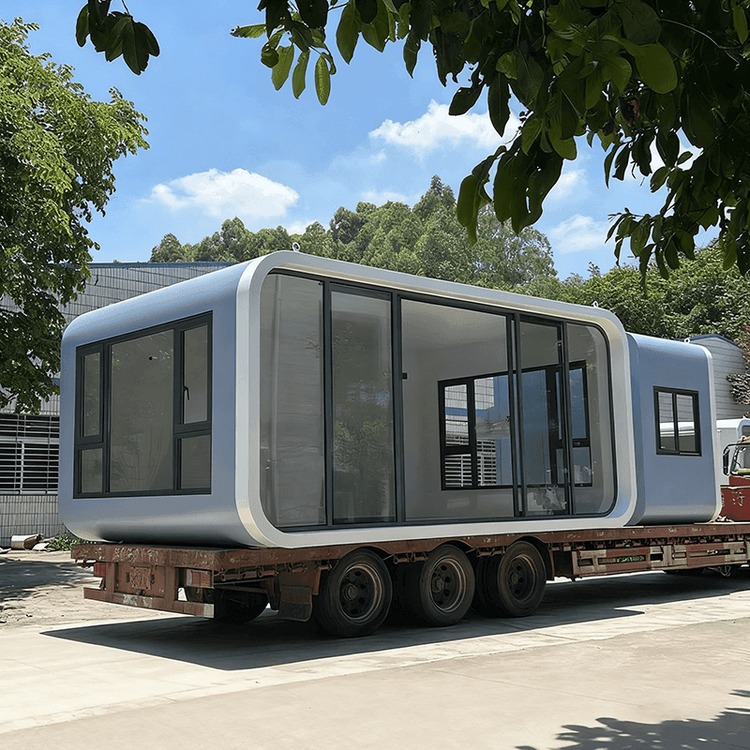
Container House in Zhuangzhai
The application of container houses in Zhuangzhai Town needs to be combined with local industrial characteristics and actual needs. Currently, there are no direct cases, but they can meet the needs of characteristic industries and temporary housing through modular design. The following analysis is carried out from the perspectives of technical adaptability, application scenarios, and industrial synergy.

I. Technical Adaptability: Modular Design Fits the Industrial Needs of Zhuangzhai Town
As an important national base for artificial board production, Zhuangzhai Town has more than 1,600 enterprises and over 4,000 individual businesses, with more than 90,000 wood processing employees. The modular design of container houses can be quickly assembled into temporary offices, warehouses, or employee dormitories. For example, using "packing-box container houses", their hot-dip galvanized cold-formed steel frames and fire-resistant polyurethane sandwich panel structures can not only meet the rapid construction needs of construction site dormitories and office areas but also comply with fire safety standards. In addition, the customizable nature of light steel keel houses can be adapted to scenarios such as homestays and supporting housing in scenic spots. If Zhuangzhai Town expands its cultural and tourism industry in the future, such houses can achieve differentiated competition by flexibly adjusting their appearance and layout.
II. Application Scenarios: Covering Temporary Housing and Long-term Residential Needs
- Temporary Housing: In response to the short-term project needs of wood processing enterprises, the "reusable and dismountable" characteristic of container houses can reduce the cost of repeated construction. For example, functional booths can be quickly deployed as security booths or environmental protection public toilets to meet the infrastructure needs around factories.
- Long-term Residence: If enterprises need to provide long-term accommodation for employees, the insulation material filling and metal panel walls of light steel keel houses can improve living comfort, and their earthquake resistance and sound insulation performance are also better than those of traditional prefabricated houses.
III. Industrial Synergy: Combining Local Supply Chains to Optimize Costs
The wood processing industry in Zhuangzhai Town, with an annual output value of 75 billion yuan, can provide partial raw material support for container houses. For example, the floor material can be selected from locally produced cement fiber boards, and the wall panels can use rock wool or glass wool sandwich panels to reduce transportation costs. In addition, if container house manufacturing enterprises are introduced, a localized industrial chain of "steel processing - wall prefabrication - house assembly" can be formed, further reducing costs and shortening delivery cycles.
IV. Policy and Market Trends: Low-carbon Attributes Support Sustainable Development
According to industry trends in 2026, the low-carbon attributes of dismountable and relocatable container houses (such as a 90% reduction in construction waste emissions and an average of more than 8 dismountable and reusable times) comply with domestic circular economy policies. If Zhuangzhai Town promotes green construction in the future, such houses can serve as an upgrade plan for temporary buildings, replacing traditional disposable prefabricated houses.