
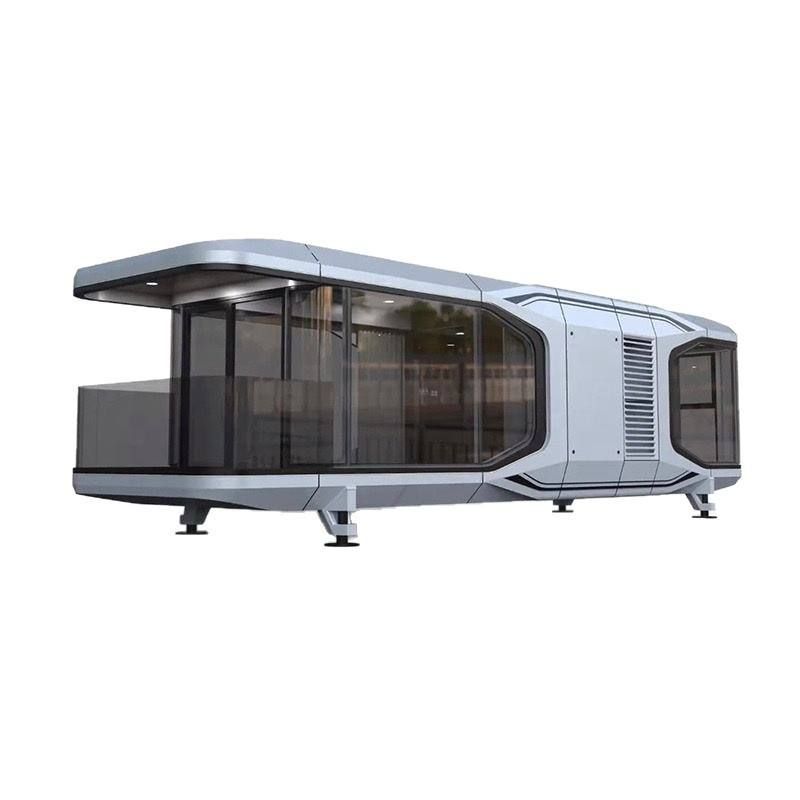
Container House with Through Windows
Container houses with through windows achieve a combination of ventilation, lighting, and functionality through optimized window designs, with common implementations including double-layer thermal-break aluminum windows and breathing side window designs. The following illustrates their technical features and application scenarios with specific examples:
1. Double-Layer Thermal-Break Aluminum Windows: Dual Optimization of Insulation and Ventilation
Take a custom orange container house as an example. It features large double-layer thermal-break aluminum windows paired with Ford blue tempered coated glass and a KFC double-door design. The double-layer thermal-break aluminum structure effectively blocks heat conduction through the combination of insulated glass and thermal-break aluminum profiles, reducing heat transfer from the outdoors in summer and minimizing heat loss from indoors in winter while maintaining window airtightness. The Ford blue tempered coated glass not only offers high strength and safety but also reflects part of the solar radiation through its coating layer, further lowering indoor temperatures. The KFC double-door design enables rapid ventilation through large-area opening, making it particularly suitable for scenarios requiring quick air exchange, such as kitchens or densely populated areas.
2. Breathing Side Window Design: Integration of a Natural Ventilation System
The case of a seaside container homestay demonstrates another ventilation strategy—forming a natural ventilation system through the联动 (linkage) of “breathing” walls and side windows. When the side windows are opened in summer, air enters from the bottom, creating an upward airflow through the thermal pressure principle, which drives indoor air circulation. This design achieves passive cooling without relying on mechanical ventilation equipment, making it especially suitable for coastal areas with mild climates and stable winds. The height and opening angle of the side windows require fluid dynamics calculations to ensure that the wind speed and coverage meet requirements while preventing rainwater ingress or structural damage caused by strong winds.
3. Extended Comprehensive Functions of Window Design
Although the container dormitories in Shenzhen's urban villages do not directly mention through-window structures, they improve living experiences through window design. For example, well-planned windows can guide sunset light to enhance indoor lighting quality while incorporating soundproof cotton to reduce external noise interference. Such designs indicate that the functions of through windows are not limited to ventilation; they can also achieve multi-objective coordination, such as lighting, heat insulation, and noise reduction, by optimizing parameters like orientation and glass light transmittance, thereby improving the overall livability of container houses.
In summary, container houses with through windows achieve efficient ventilation and functional expansion within limited spaces through material innovations (such as double-layer thermal-break aluminum and coated glass) and structural optimizations (such as breathing side windows and double-door designs), providing sustainable solutions for temporary buildings, homestays, dormitories, and other scenarios.



