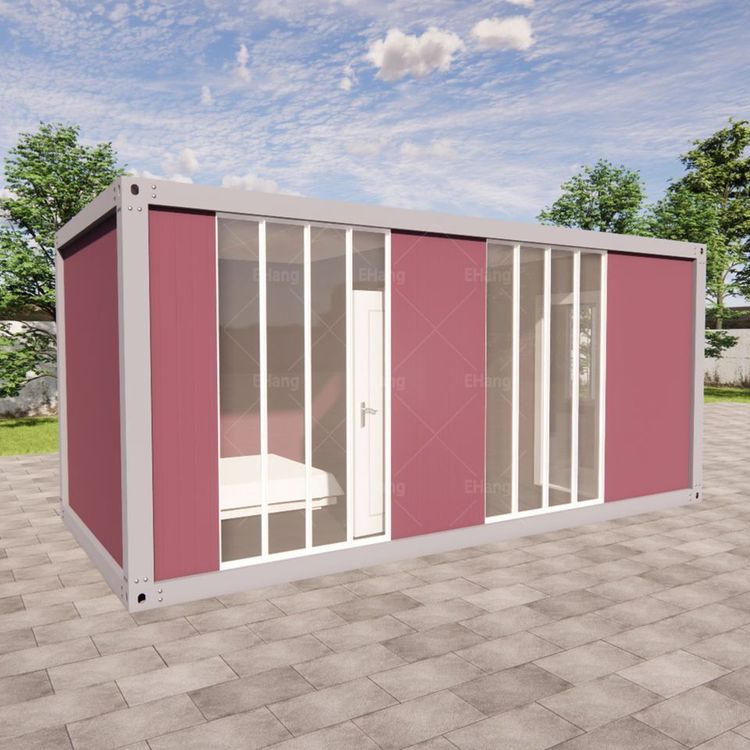
Background of Container House Promotion
The background of promoting container houses mainly stems from multiple factors such as the transformation of the construction industry, policy support, changes in market demand, and technological progress.

Transformation of the Construction Industry and Green Building Trends
Against the backdrop of the transformation and upgrading of the construction industry, traditional construction methods face issues such as resource waste and environmental pollution. As a modular form of construction, container houses have core innovations in "unitization" and "reversibility". Containers themselves are standardized steel units with high structural strength, allowing for multi-layer stacking and horizontal splicing. During the construction phase, wet operations are significantly reduced, lowering dust and noise pollution. Their weathering steel shells undergo anti-corrosion treatment, with a service life of several decades, and the materials are recyclable, meeting the requirements for resource conservation and recycling in green building evaluation systems. For example, transforming a standard container can reduce carbon emissions from steel production by approximately 3.5 tons, making it suitable for temporary buildings, construction site dormitories, and other scenarios.
Policy Support and Industry Standard Guidance
The state has increased its support for prefabricated and modular buildings, with multiple provinces and cities introducing policies requiring a certain proportion of prefabricated buildings in new constructions. As an important form of modular buildings, container houses have shifted from being an "optional choice" to a "mandatory choice," with policy dividends becoming a certainty for industry development. For instance, recent trending topics such as "the continuous rise in the penetration rate of prefabricated buildings" and "modular buildings receiving strong policy support" reflect the shift in policy from "encouragement" to "mandatory implementation."
Changes in Market Demand and Expansion of Application Scenarios
The application scenarios of container houses have expanded from temporary construction site housing to cultural tourism, commerce, public services, and other fields. Their flexibility, cost-effectiveness, and environmental friendliness meet diverse needs, such as scenic area homestays, urban commercial spaces, rural residences, and emergency shelters. For example, in the cultural tourism sector, container houses are used to create unique accommodation experiences, while in the commercial sector, container house bars and cafes are opening up creative business models. Additionally, with the increasing demand for mobility in living spaces during urbanization, container houses redefine the composition of living units through prefabrication and thermal performance compensation.
Technological Progress and Improvement in Product Performance
With technological advancements, container houses have seen significant improvements in structure, safety, cost, and comfort. The application of high-strength steel structures, anti-rust and fire-resistant processes, and thermal insulation materials endows them with wind, rain, heat, and sound insulation properties, even surpassing those of ordinary residences. Factory prefabrication reduces construction waste, saves costs, and ensures an environmentally friendly production process, with material waste reduced by 60%-70% compared to traditional construction.