Container House Production Technology
Container house production technology primarily involves material selection, structural design, enclosure construction, connection nodes, and industrial manufacturing processes.
I. Material Selection and Structural Design
Container houses use high-strength weathering steel (such as Q355B grade) as the main frame material, with a yield strength approximately 30% higher than that of ordinary carbon steel, supporting a box structure with an aspect ratio close to 2:1. A self-balancing system is formed through rigid connections between corner fittings and side beams, with the top longitudinal corrugated plate dispersing stress through its corrugated geometry, reducing local buckling risk and lowering material usage by about 15%. Some companies adopt cold-formed thin-walled steel or light steel keel structures, optimizing stress points through computer simulation, resulting in a framework weight only one-fourth that of traditional brick-concrete structures while enhancing wind and earthquake resistance.
II. Thermal Performance Optimization of Enclosure Structures
The enclosure system employs a three-layer composite construction of "rock wool-air layer-aluminum-zinc coated plate":
- Rock wool layer: With a thickness of 75-100 millimeters, fibers are arranged perpendicular to the heat flow direction, with a thermal conductivity below 0.040 W/(m·K);
- Air layer: A 5-millimeter closed cavity inhibits convective heat transfer, with an overall heat transfer coefficient (U-value) below 0.5 W/(m²·K).
This design reduces condensation risk in low-temperature environments, extends the lifespan of steel structures, and lowers heating energy consumption.
III. Connection Nodes and Seismic Adaptability
For areas with seismic fortification intensity above 7 degrees, a dual-fixing mode of "wedge lock + high-strength bolt" is adopted:
- Wedge lock: Made of 45# steel through heat treatment, with a 15-degree inclined surface design that produces a self-locking effect under horizontal shear forces;
- High-strength bolt: In vibration table tests simulating an 8-degree rare earthquake, node displacement is controlled within 3 millimeters, outperforming conventional welded nodes by about 40% in deformation amplitude.
The detachable connection method supports secondary relocation and repeated assembly, reducing construction waste.
IV. Industrial Manufacturing Process
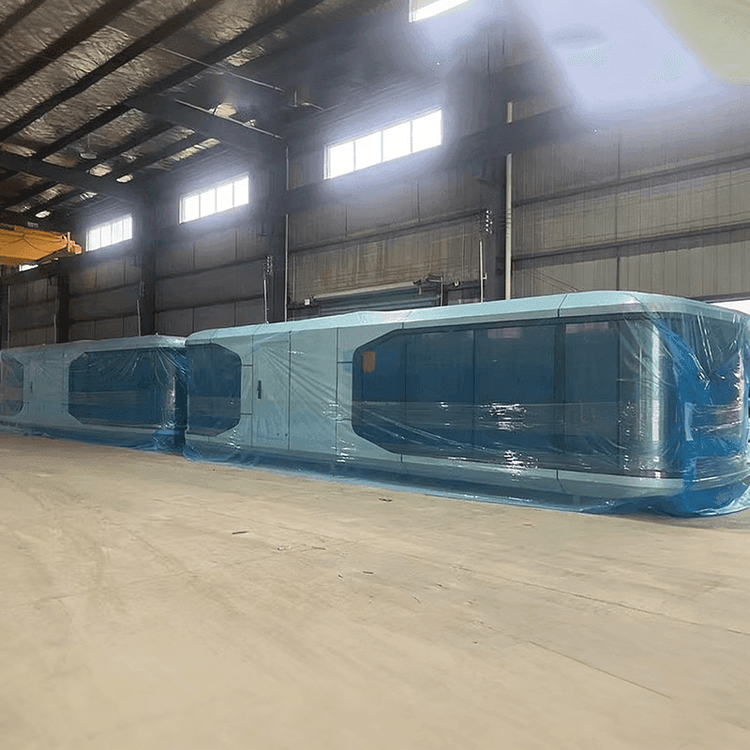
Container house production achieves standardized design and assembly-line operations:
- Structural assembly: Steel materials are cut and processed, followed by welding and anti-corrosion treatment of the main frame;
- Parallel construction: Multiple processes such as water and electricity pipelines, insulation layers, doors and windows, and interior decoration are carried out simultaneously;
- Precision control: Fully automated production lines maintain manufacturing precision at 1-2 millimeters, with a daily production capacity of 50 modules;
- Digital management: Each module is equipped with a unique QR code identity tag, enabling full lifecycle quality traceability.
V. Low-Carbon Circular Technology
Leading companies' products achieve an average of over 8 disassembly and reuse cycles, reducing construction waste emissions by about 90% compared to traditional temporary buildings. For example, adopting a bridge-cutoff lining structure reduces heat conduction channels, raising indoor temperatures by 8-10 degrees Celsius above the outside in winter without heating, reducing reliance on heating equipment energy consumption.