
Container House Production and Manufacturing
The production and manufacturing of container houses involve core processes such as standardized design, industrial production, modular integration, and rapid on-site assembly.
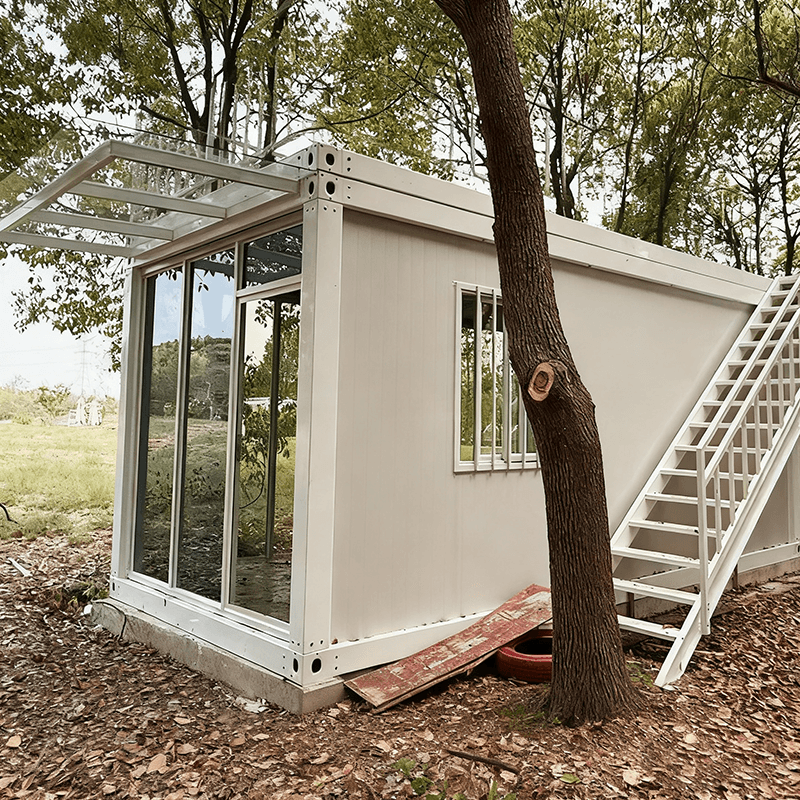
1. Standardized Design and Modular Disassembly
Container houses are composed of modular units as their basic building blocks, disassembling the entire building into standardized components such as the floor, roof, four sides, or directly adopting complete 'room modules'. The design phase requires uniform dimensions, interfaces, and functional layouts to ensure that each module can be independently manufactured in the factory and then precisely assembled into a complete building. For example, the concrete MiC production line in a smart construction industrial park in Shenzhen can produce a complete module every 20 minutes, with each module carrying a unique QR code identity tag that includes all production records.
2. Industrial Production Process
The production process is highly systematic, with steel undergoing cutting and processing before entering the structural assembly phase. After completing the main framework, welding, corrosion protection, enclosure installation, and internal functional module construction are carried out sequentially. Processes such as plumbing, HVAC, insulation, and door and window installation are synchronized and interwoven, forming a streamlined operation with multiple processes advancing in coordination. For instance, a 400-meter fully automated production line in a steel structure modular smart factory in Guangdong utilizes robotic collaboration and AGV (Automated Guided Vehicle) transportation to produce 50 steel structure modules per day, with manufacturing precision consistently controlled within 1-2 millimeters.
3. Modular Integration and Prefabrication Level
Modules complete the main structure, interior and exterior wall decoration, pipeline embedding, and internal facility integration within the factory. For example, modules produced by China Construction Integration Architecture for an Australian project integrate plumbing, decoration, and even soft furnishings, requiring only the connection of utilities on-site for 'move-in readiness'; the packing-box units from Suzhou Zhongnan Steel Structure come pre-installed with interiors and facilities before leaving the factory, ready for immediate use upon hoisting. This fully prefabricated approach reduces construction errors from the centimeter level to the millimeter level, minimizing the need for on-site modifications.
4. Rapid On-Site Assembly and Construction Efficiency
After being transported to the site, modules are assembled into the complete structure through hoisting and splicing. Installation efficiency is significantly higher than that of traditional buildings: Suzhou Zhongnan's quick-assembly containers require only 2 hours for a single unit installation, with 10 standard dormitories capable of being erected within a day; CIMC's standard container houses take 3 hours for installation, whereas traditional construction methods may exceed 8 hours for a single unit. The Qatar World Cup Fan Village project adopted a 'factory prefabrication + on-site quick assembly' model, delivering 1,000 accommodation modules within 3 months, shortening the industry average construction period by 40%.



