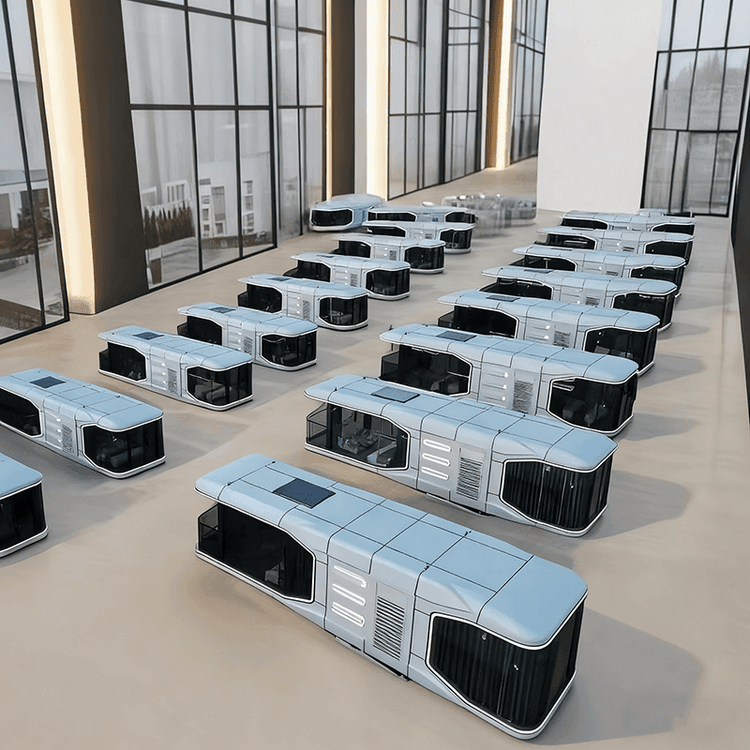
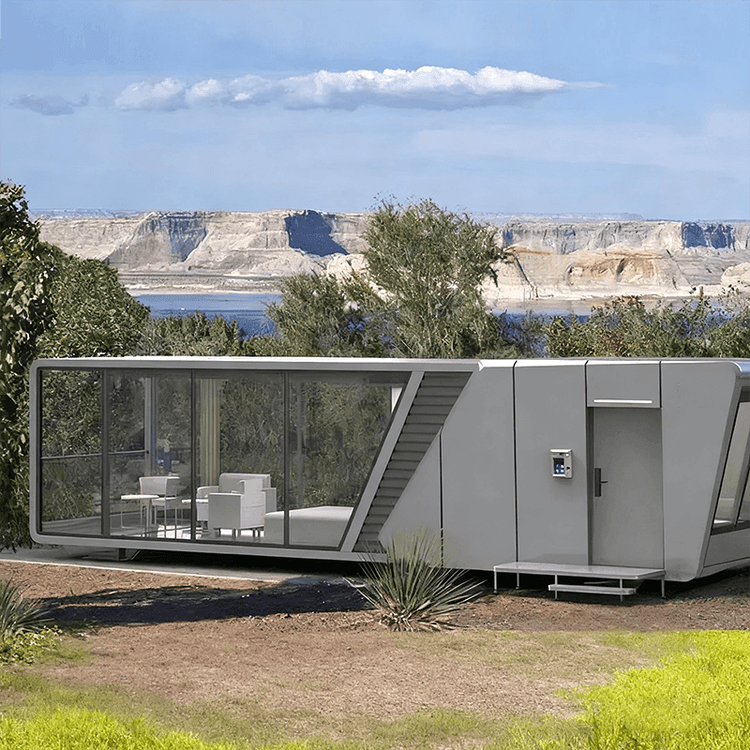
Container House and Prefabricated House
Both container houses and prefabricated houses belong to the prefabricated building system, but container houses are based on standardized container modules, while prefabricated houses are assembled on-site using building components prefabricated in factories. There are differences between the two in terms of modularity, application scenarios, and technical characteristics.

Modularity and Construction Logic
Container houses use fixed-size containers as basic modules. The main structure, water and electricity pipelines, and interior decoration are completed in the factory. After being transported to the site, they are directly spliced or stacked to form a complete building. For example, the container houses used in the Nagoya Asian Games were quickly built as athlete accommodations through modular design. Prefabricated houses, on the other hand, break down the building into components such as floors, roofs, and walls, which are prefabricated in the factory and then transported to the site for assembly. Their modularity is slightly lower than that of container houses, but the combination of components is more flexible and can adapt to different building forms.
Application Scenarios and Functional Adaptation
Container houses, with their uniform modules and convenient transportation, are often used in temporary or mobile scenarios, such as engineering camps, emergency support, cultural tourism homestays, etc. For example, the quick-assembly containers from Suzhou Zhongnan Steel Structure Co., Ltd. can be installed in just 2 hours per set and support on-demand splicing, making them suitable for engineering camps that require rapid delivery. Prefabricated houses are more suitable for long-term buildings, such as residential buildings and commercial complexes. Through the combination of components, personalized design can be achieved to meet complex functional requirements. For example, the 18-story residential project in Hong Kong undertaken by China Construction Steel Structure adopted a prefabricated construction plan, shortening the construction period by 60%-70% compared to traditional methods.
Technical Characteristics and Performance
Container houses mainly feature steel structure frames and have outstanding wind and earthquake resistance. For example, the packing containers from Suzhou Zhongnan have a wind resistance rating of Level 12 and an earthquake resistance rating of Level 8, with a frame deformation rate of only 0.18%, far below the industry's qualified threshold of 0.3%. Prefabricated houses achieve structural stability through component connection technologies, such as high-strength bolt connections and wedge-shaped lock fixings, which can withstand strong typhoons and earthquakes. For example, Yiqi Container Activity House Co., Ltd. uses a "wedge-shaped lock + high-strength bolt" connection node, controlling the displacement within 3 millimeters in a simulated magnitude 8 earthquake, which is better than conventional welded nodes.
Recycling and Environmental Advantages
Both support multiple disassembly and reassembly for recycling, but container houses have stronger reusability due to their uniform modules. For example, compliant products can be disassembled and reused an average of more than 8 times, reducing construction waste emissions by about 90% compared to traditional fixed temporary buildings. Prefabricated houses reduce on-site construction waste through standardized component design, aligning with green construction policy guidelines.