
Partition Materials for Container Houses
Container houses typically use wooden walls, glass, light steel keel partition walls, or customized cabinets as partition materials. The specific choice needs to be comprehensively determined based on functional requirements, spatial layout, and design style. Here are the detailed explanations:
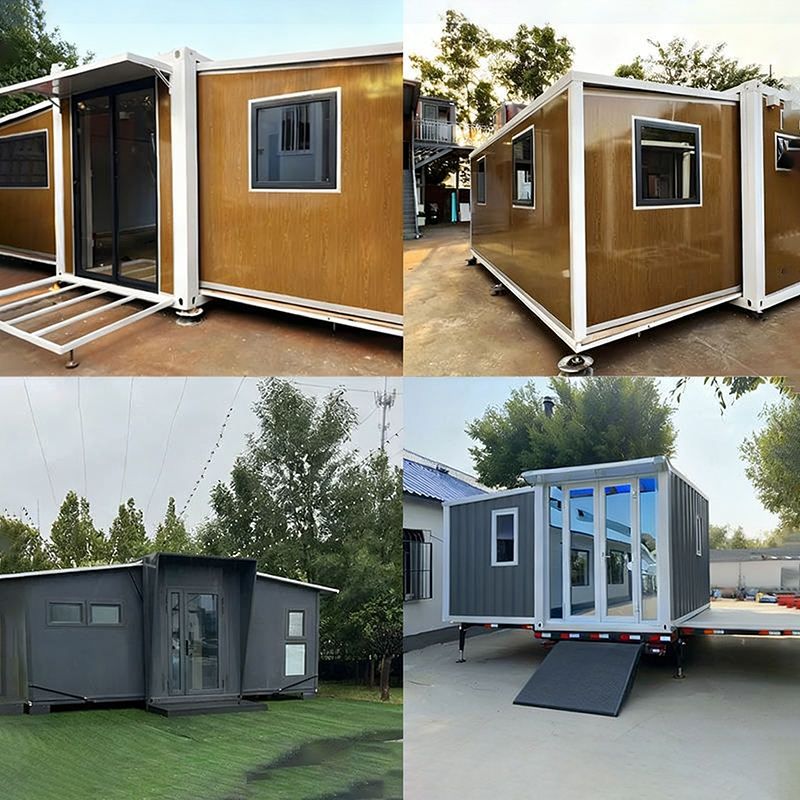
Wooden Wall Partitions
Wooden walls are one of the most commonly used partition materials in container houses, especially when there is a need to clearly define functional areas. For example, wooden walls are often used as partitions in bathrooms and kitchens, meeting the requirements for spatial division while creating a warm atmosphere through the natural texture of the wood. In some cases, wooden walls are combined with blue gradient tile paving, which is not only aesthetically pleasing but also waterproof and moisture-proof, suitable for outdoor simple facilities environments. Additionally, wooden wall construction is relatively simple, cost-effective, and easy to integrate with other interior design styles.
Glass Partitions
Glass partitions are suitable for scenarios where maintaining spatial transparency is desired, such as between living rooms and dining rooms, or bedrooms and studies. By installing large floor-to-ceiling windows, glass doors, or glass partitions, natural light can be introduced, enhancing indoor brightness and visually expanding the space. For example, some designs use glass curtain walls as exterior facade treatments, breaking away from the industrial feel and creating a villa-like atmosphere. The drawback of glass partitions is their relatively weak sound insulation, which can be improved by using double-glazed glass or soundproof films.
Light Steel Keel Partition Walls
Light steel keel partition walls use cold-formed thin-walled light steel keels as the load-bearing structure, filled with insulation materials (such as rock wool or glass wool), and covered with metal panels or calcium silicate boards. This type of partition combines insulation, sound insulation, and fire resistance, making it suitable for areas with high comfort requirements, such as bedrooms or living rooms. Its advantage lies in its flexibility in customizing floor plans and appearances, as well as its environmentally friendly materials that align with low-carbon building trends. In some cases, light steel keel partition walls are combined with multifunctional furniture such as folding beds and folding tables to enhance space flexibility.
Customized Cabinet Partitions
In small-sized container houses, customized cabinets are often used as functional partitions. For example, a linear kitchen counter combined with opposite cabinets and overhead cabinets not only expands storage space but also naturally divides the kitchen and dining areas. Additionally, open shelving units, bookshelves, or storage racks can serve as soft partitions, maintaining spatial transparency while increasing practicality. In some designs, cabinet partitions are decorated with black special materials (such as fire-resistant and high-temperature-resistant panels) to enhance visual hierarchy.



