
Back to blog
Article
Container House and Mobile Panel House
Admin September 15, 2026
Container houses and mobile panel houses are two common types of temporary or semi-permanent building forms in the modular construction field. They are characterized by flexibility, portability, and controllable costs, and are widely used in scenarios such as construction site offices, temporary accommodations, and commercial pop-up stores. The following provides an introduction from four aspects: types, structural performance, application scenarios, and purchasing considerations.
Types
- Container-style: Modified from standard containers, with common sizes of 20 feet and 40 feet. They can be used as single units or combined by multiple units. They have a sturdy structure and are easy to transport, making them suitable for project departments and construction site command centers.
- Foldable: Designed with a folding structure, they compress in volume during transportation and can be quickly unfolded on-site. The unfolding time for a single unit can be controlled within 30 minutes, making them suitable for office needs that require frequent relocation, such as exploration teams and temporary command posts.
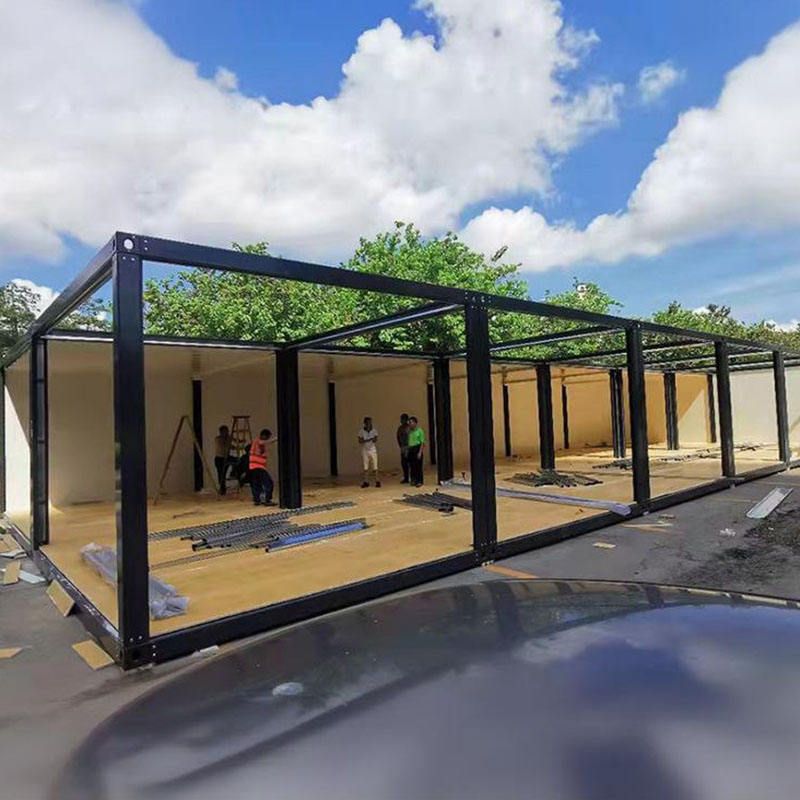
- Assembled: Composed of light steel frames and color-coated steel sheets, they are assembled on-site in a modular manner. They can be flexibly expanded according to the number of people and functional divisions, and are commonly seen in temporary offices in industrial parks and event planning sites.
- Expandable: Additional side or end expansion cabins are added to the container base, increasing the usable area by 30%-50% after expansion. They are suitable for long-term on-site offices with high requirements for space comfort.
- Customized and creative: Incorporating elements such as glass curtain walls, wood-grain finishes, and irregular structures, they are used in brand displays, cultural and creative parks, and high-end temporary offices, balancing functionality and visual expression.
Structural Performance
- Structural stability: It is a core safety indicator directly related to the safety of people and property during use. High-quality products adopt a full steel structural frame, with low deformation rates under extreme conditions (such as coastal typhoons of level 12 and high-intensity earthquakes of level 8), demonstrating strong wind and earthquake resistance.
- Installation efficiency: The installation cycles of different types of products vary greatly. Foldable and quick-assembly types have high installation efficiency, with the installation time for a single unit controlled within 2-4 hours, making them suitable for rapid delivery scenarios.
Application Scenarios
- Engineering camps: Require rapid delivery, and foldable and quick-assembly container houses are the preferred choices.
- Government and enterprise temporary buildings: Need to be adapted to specific functional layouts, and assembled and expandable container houses are more suitable.
- Commercial pop-up stores: Require flexible adjustment of space forms, and customized and creative container houses can meet the needs.
Purchasing Considerations
- Structural stability: Prioritize verifying the product's wind and earthquake resistance test reports to ensure compliance with relevant standards.
- Installation efficiency: Choose products with short installation cycles and strong layout adjustment capabilities according to the project delivery time requirements.
- Materials and workmanship: Pay attention to the thickness of steel, the density of the insulation layer, and the anti-corrosion process to ensure product durability and comfort.
- Brand and service: Choose qualified and well-reputed brands to ensure the quality of after-sales service.



