
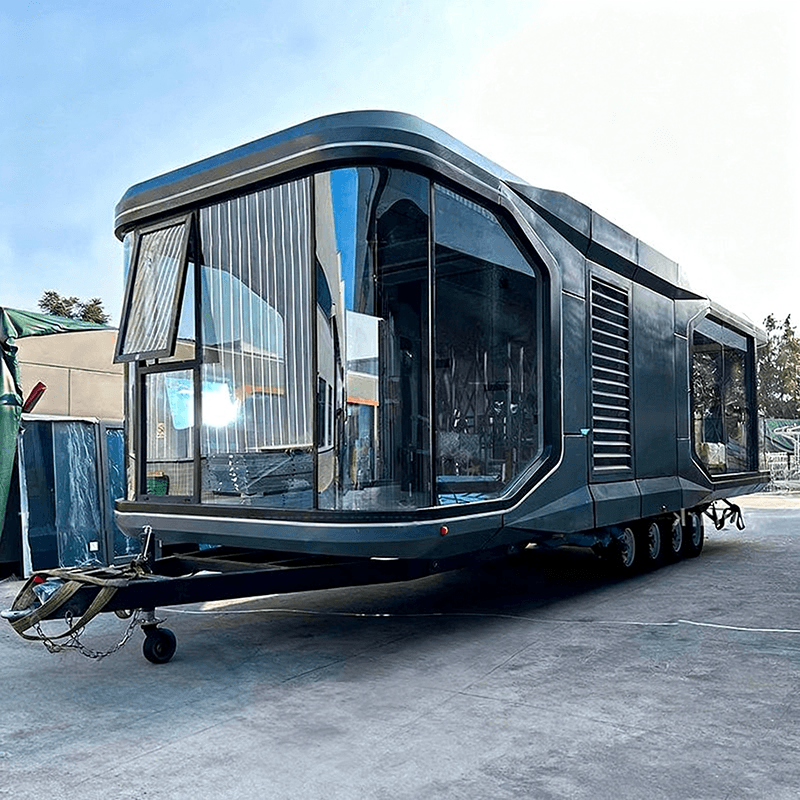
Container House Material Introduction Diagram
The main materials of container houses include wall panels, frames, floors, ceilings, and accessory materials. Different parts use specific materials to meet functional requirements.
Wall Panel Materials
Both the inner and outer sides of the wall panels in container houses often use orange-peel-patterned color-coated steel composite panels. The surface features a special embossing process that creates subtle concave-convex structures, dispersing the flow path of rainwater and preventing water accumulation and rust. The double-sided orange-peel-patterned color-coated steel layers enhance rigidity through their physical form, with Grade A fire-resistant rock wool (which does not soften or deform at 800°C and releases no toxic fumes) filled in between. This combination provides fire resistance, non-toxicity, and pressure resistance. After machine compression and sealing, the pressure resistance is significantly improved, preventing depression during transportation or stacking.
Frame Materials
The overall frame is primarily made of hot-dip galvanized square tubes, which form a composite structure through the metallurgical bonding of a zinc alloy coating with steel. The compressive strength reaches 150-160 kg/m³, allowing it to withstand the load of three stacked layers and extreme weather impacts, adapting to highly corrosive environments. The frame joints use full-weld processes, increasing longitudinal rigidity by over 30%, extending the anti-corrosion cycle by three times compared to cold-dip galvanizing, and providing a service life of over 20 years. The zinc layer is 100% recyclable. The folding hinges use hot-dip galvanized full-weld processes, with stainless steel axles that can withstand over 100,000 opening and closing frictions, preventing rust and jamming. The external hinges have reserved drainage holes to prevent rainwater accumulation, with an exclusive patented design.
Floor and Ceiling Materials
The floors and ceilings are standardly equipped with Grade A fire-resistant magnesium oxide boards, primarily made of magnesium oxide cement and glass fibers. They meet the A1 non-combustible standard for combustion performance, with a fire resistance limit of ≥5 hours and smoke toxicity of AQ1 (non-toxic release). A 15mm thick standard board can achieve a load-bearing capacity of 8 tons/m², supporting three stacked layers, and is waterproof and moisture-proof, with an absorption rate of ≤3% after 48 hours of immersion.
Other Accessory Materials
The accessory materials for container houses include high-strength steel, aluminum alloys, stainless steel, etc., used for pre-installation in systems such as doors, windows, electrical, and water supply and drainage, ensuring structural integrity and functionality.



