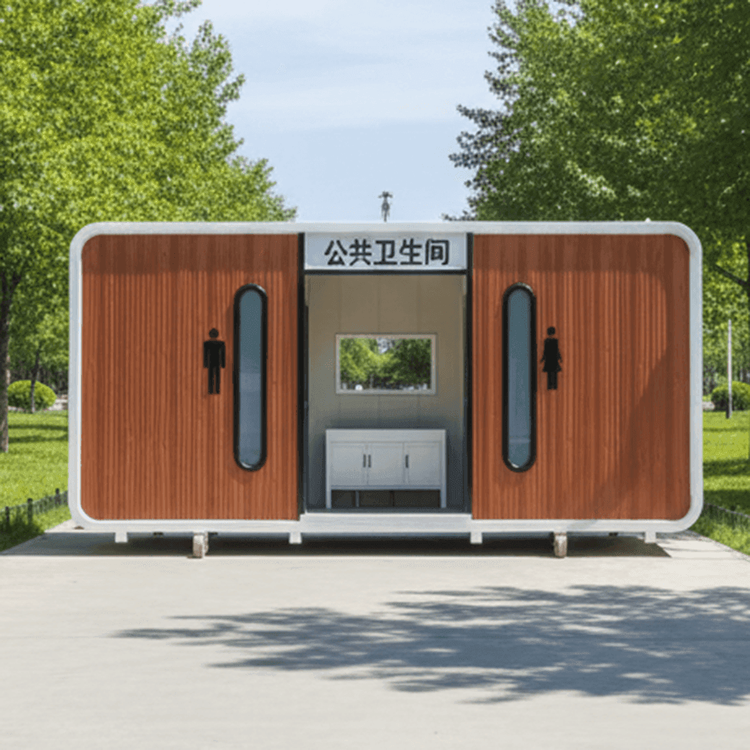
Introduction to Container Houses
Container houses are modular buildings manufactured using specialized container panels and processes, featuring mobility, rapid assembly, safety, and durability. Here is a detailed introduction to container houses:

I. Structural Characteristics
The main structure of container houses is made of steel frames, typically using welded integral containers or bolt-connected assembled containers. Welded containers are formed by integral welding in factories, with direct load paths and strong resistance to deformation, suitable for frequent lifting and moving. Bolt-connected assembled containers use standard panels connected by bolts, with multiple connection nodes in the load paths, and overall stability affected by the tightness of the nodes. The surfaces of these containers are usually treated with hot-dip galvanizing, providing a long anti-corrosion lifespan. Especially in areas with large temperature differences between day and night and significant humidity changes, the quality of the coating directly determines the rusting speed of the containers.
II. Performance Advantages
- Safety and Durability: Steel frame structures are wind and earthquake resistant, with steel plate exteriors that are corrosion-resistant, acid-resistant, rust-free, and crack-free, with a service life of over 20 years.
- Sound Insulation and Thermal Insulation: With air-break thermal designs, they offer excellent sound and thermal insulation. Some products use special fillers, thermal reflection, and ventilation interlayers to achieve superior thermal insulation effects for building envelopes, reducing temperatures by 5-8℃.
- Rapid Assembly: They have short manufacturing periods, require no foundations, and can be occupied immediately after on-site lifting and placement. Some products support on-demand splicing and combination, allowing for the rapid completion of large-scale constructions.
- Mobility: They can be moved as a whole without on-site disassembly and assembly, significantly reducing on-site secondary utilization costs and adapting to the needs of frequently changing locations.
III. Application Scenarios
Container houses have covered dozens of scenarios, including engineering camps, commercial pop-ups, and temporary government and enterprise constructions, such as container dormitories, container shops, container offices, and mobile houses. Specialized containers can also be customized according to the needs of specific scenarios.