Back to blog
Article
Tiling Interior Walls of Container Houses
Admin September 17, 2026
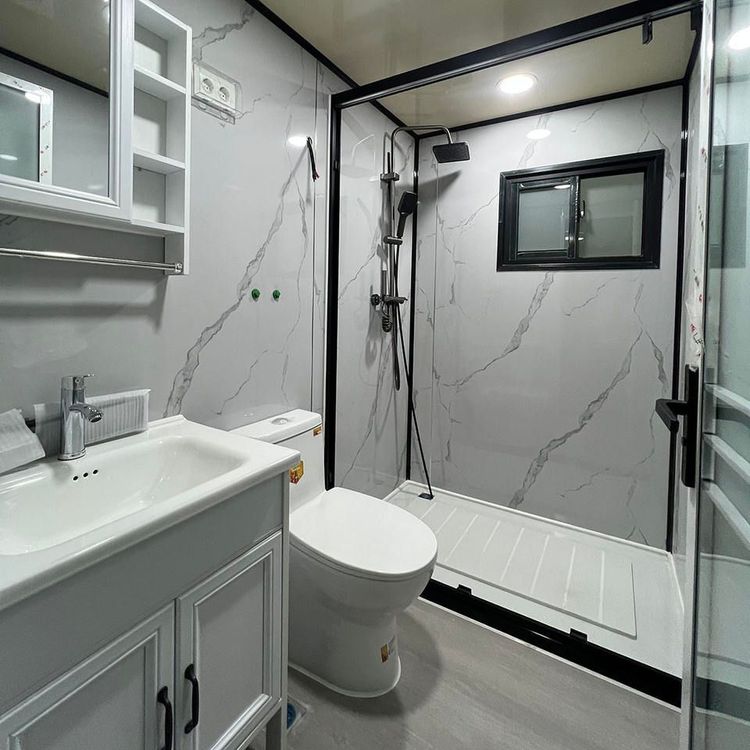
The interior walls of container houses can be tiled, but it is necessary to strictly follow specifications for material selection, construction process, environmental safety, etc., and implement after weighing the advantages and disadvantages.

Material Selection
- Tile Types: Prioritize durable materials such as concrete tiles and putty wall tiles, avoiding ordinary fragile tiles. These materials are highly impact-resistant and more suitable for the vibrating environment of container structures.
- Tile Adhesive Adaptation: Select the adhesive grade based on tile specifications. C1 grade can be used for small to medium-sized tiles; large tiles or slabs require C2 grade or above, with attention to anti-slip (T) and flexibility (S1/S2) properties. For example, container walls may experience slight deformation due to temperature changes, and flexible tile adhesive can reduce the risk of cracking.
- Special Scenario Overlay: If the wall involves heat sources such as underfloor heating or flues, a higher flexibility grade of tile adhesive should be overlaid to prevent tile detachment due to thermal expansion and contraction.
Construction Process
- Foundation Preparation: Thoroughly clean the wall surface, removing oil stains and dust, ensuring a flatness error of ≤3mm/2m; check the structural integrity of the container to avoid tile hollowing due to wall loosening.
- Tiling Sequence: Construct from bottom to top, with a leveling layer (thickness ≥20mm) required on the ground; use a level for each row of tiles, and professionally cut corners (e.g., 45° beveling) to ensure tight joints.
- Gap Treatment: Clean the tile joints within 24 hours after tiling, grout with special joint filler, controlling the depth at 3-5mm to ensure uniform gaps; wipe off residual joint filler on the surface after completion to avoid difficulty in removal after curing.
Environment and Safety
- Environmental Control: During construction, the humidity should be ≤85%, and the temperature should be between 5-35°C to avoid the adhesive's bonding strength being affected by low temperature or high humidity; thoroughly clean before construction to reduce dust interference with the bonding layer.
- Safety Protection: Operators should wear dust masks and goggles to prevent tile debris from being inhaled or splashed into the eyes; ensure scaffolding is stable during high-altitude operations, and materials are stacked neatly to avoid tipping and injury.
Advantages and Disadvantages Analysis
- Advantages: Enhances aesthetics and practicality; tile surfaces are easy to clean, waterproof, and antibacterial, extending the service life of container houses; especially suitable for damp areas such as kitchens and bathrooms.
- Disadvantages: Higher cost (material + labor costs are approximately 1.5-2 times that of ordinary walls); difficult to change the layout after installation, requiring reasonable planning of functional zones in advance.
Precautions
- Estimate Usage: Measure the wall area in advance, calculate the quantity according to tile specifications, and reserve a 5%-10% loss.
- Standardized Construction: Avoid hollowing (check by knocking), loosening (test by pushing), and cracking (observe joints), ensuring a tile flatness error of ≤1mm/m.