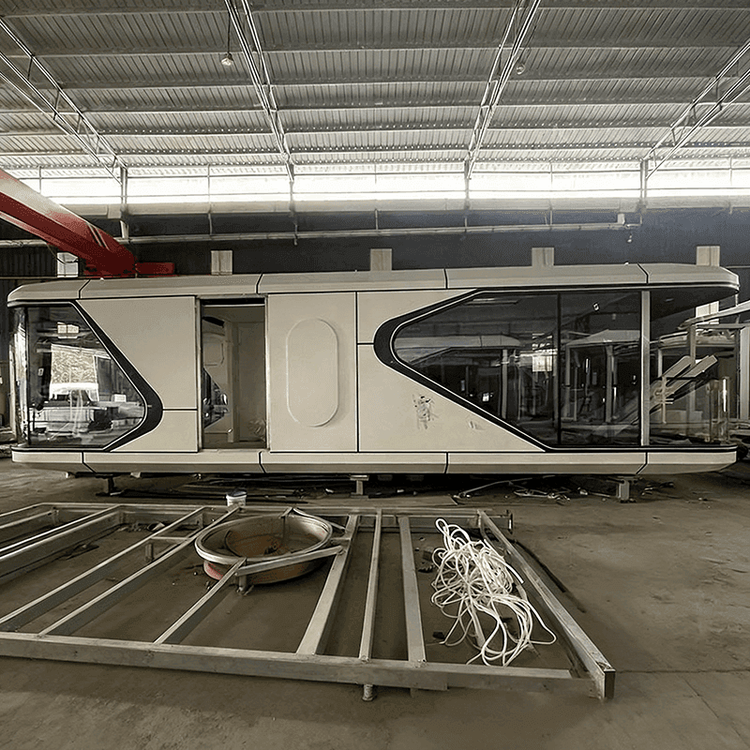
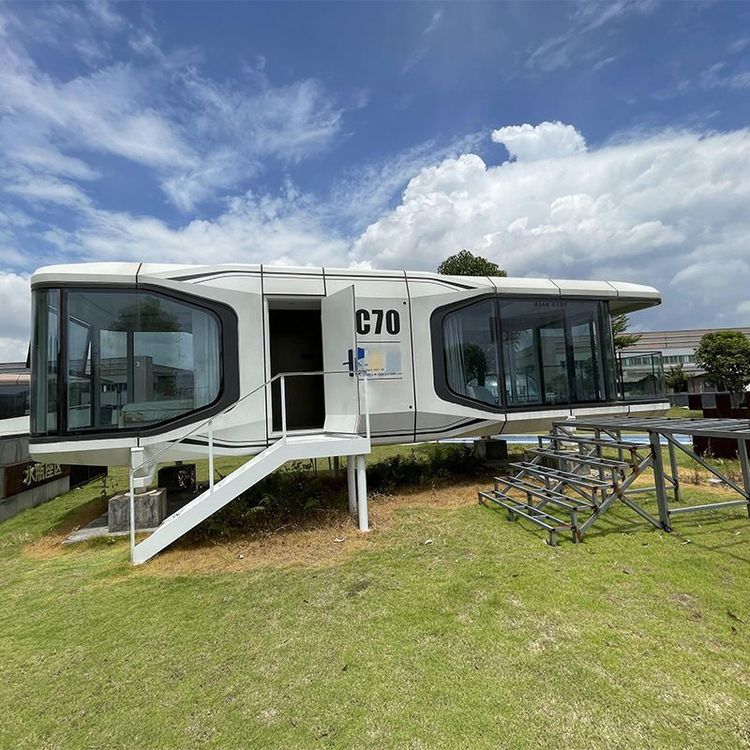
Cold Protection for Container House Homestays
Cold protection for container house homestays in cold regions such as Northeast China requires comprehensive adaptation in terms of materials, processes, and design.

I. Key Cold Protection Technologies
Insulation Layer Optimization Thickened insulation materials (such as rock wool boards and polyurethane foam) should be used, with a thickness of over 100mm, to ensure stable indoor temperatures at -30°C. For example, the customized products of Jilin Jinlin Metal Structure Manufacturing Co., Ltd. effectively block the cold bridge effect through a double-layer insulation design, keeping the indoor temperature difference within 5°C in winter.
Sealing Performance Enhancement A double-layer sealing, waterproof, and cold-proof process is adopted. Silicone weather-resistant sealant is used at the joints of doors and windows, and cold-proof strips are added at the connections between walls and the ground. A camping base project in Northeast China has completely solved the problems of air leakage and frost formation through this process, maintaining an indoor temperature of over 15°C in winter without additional heating.
Structural Cold Resistance Design Steel structures should undergo anti-corrosion treatment (such as hot-dip galvanizing) to prevent low-temperature embrittlement. The roof adopts a sloped design (with a slope of ≥30°) to avoid snow accumulation, and snow load support structures are added to withstand snow pressure of over 2m.
II. Localized Adaptation Solutions
Non-standard Customization Technology According to the climatic characteristics of Northeast China, enterprises need to have non-standard customization capabilities. For example, Jilin Jinlin Company integrates the water and electricity systems into the wall interior through modular design, avoiding the risk of pipeline freezing and supporting rapid assembly and relocation to meet the flexible adjustment needs of cultural and tourism projects.
Full-chain Service Guarantee A closed loop from design, production to installation should be formed. Local enterprises can provide ready-to-use products that can be occupied immediately upon landing, without the need for civil construction, greatly shortening the preparation period. Taking a camping base project as an example, it only takes 45 days from signing the contract to putting it into use, which is 70% shorter than the construction period of traditional homestays.
III. Cold Protection Effect Verification According to actual measurements in Northeast China, container homestays using professional cold protection processes can achieve the following in winter:
- Stable indoor temperatures of 12-18°C (without active heating);
- Energy consumption reduced by over 60% compared to ordinary panel houses;
- Service life of over 15 years (when the anti-corrosion process meets the standards).
IV. Selection Recommendations Prioritize enterprises with the following qualifications:
- Complete metal structure production and installation qualifications;
- Passed national quality inspection standard certification;
- Have practical operation cases in Northeast China (such as cultural and tourism and industrial and mining projects);
- Provide cold resistance performance test reports (including low-temperature test data at -30°C).