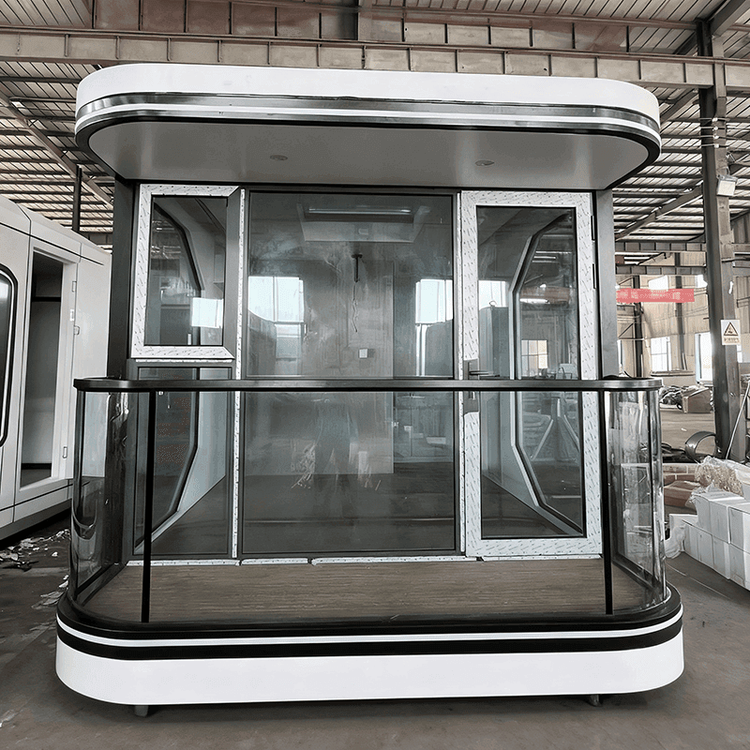
Container House with Glass Curtain Wall
Container houses with glass curtain wall designs combine aesthetics, functionality, and flexibility, serving as a typical example of innovative applications in modern architecture. The following elaborates on their design features, application scenarios, advantages, and case studies from four aspects:

1. Design Features
Glass curtain wall container houses are based on standard container structures, with upgrades in appearance and functionality achieved by replacing or adding glass curtain wall systems. The curtain walls typically use double-glazed or tempered glass, paired with aluminum alloy frames, ensuring both natural lighting and enhanced thermal and sound insulation. Some designs incorporate detachable structures, such as screw-fastened installations, facilitating easy transportation and repeated assembly. Customized designs achieve spatial expansion through modular拼接 (modular assembly), with layouts like staggered vertical and horizontal extensions adapting flexibly to various scenarios.
2. Application Scenarios
Glass curtain wall container houses are widely used in commercial, residential, and temporary construction sectors. In commercial settings, they are commonly found in cafes, bars, and offices. For instance, a company in Suzhou launched a 20-foot glass curtain wall container cafe, enhancing indoor-outdoor interaction through large glass areas. In residential scenarios, they are popular for villas, homestays, or lakeside houses, such as the Japanese-style glass house designed by Kseniia Kolesnikova, which introduces natural landscapes through glass curtain walls for a transparent living experience. In temporary construction, they are often used for construction site project offices or temporary tourist facilities, like the 13 glass curtain wall container houses customized by Beijing Changle Home for Shunyi Guantang Luya Courtyard, completed from design to installation within seven days.
3. Core Advantages
- Cost and Efficiency: Compared to traditional buildings, container houses have lower material and labor costs and shorter construction periods. For example, Ante Steel Structure's glass curtain wall packing-box units can be shipped within seven days, with four workers able to install a single unit in half a day.
- Flexibility and Sustainability: Modular designs support rapid disassembly and reuse, aligning with low-carbon and environmentally friendly principles. Some products use high-strength bolt connections, eliminating the need for welding and reducing environmental impact.
- Aesthetic and Functional Integration: Glass curtain walls break away from the industrial appearance of containers, allowing for villa-like aesthetics through thematic painting or cladding on facades. Meanwhile, rock wool insulation and sealing technologies ensure structural stability, adapting to harsh weather conditions like rain, wind, and lightning.
4. Typical Case Studies
- Commercial Application: Shanghai Tongjiuzhou Container Co., Ltd. launched a "popular movable integrated house" featuring an aluminum alloy glass curtain wall, priced at 8,800 yuan, with a seven-day replacement guarantee and 48-hour delivery, targeting homestays and office scenarios.
- Temporary Construction: Beijing Changle Home customized container houses for a Shunyi project, including 3-meter-wide glass curtain wall standard units, completing the installation of 13 houses within seven days through round-the-clock construction, demonstrating efficient delivery capabilities.
- Creative Design: Kseniia Kolesnikova's Japanese-style glass house, based on a container structure suspended over a lake, combines modern and traditional aesthetics through a rusted metal exterior and sandy ceramic interior tones.