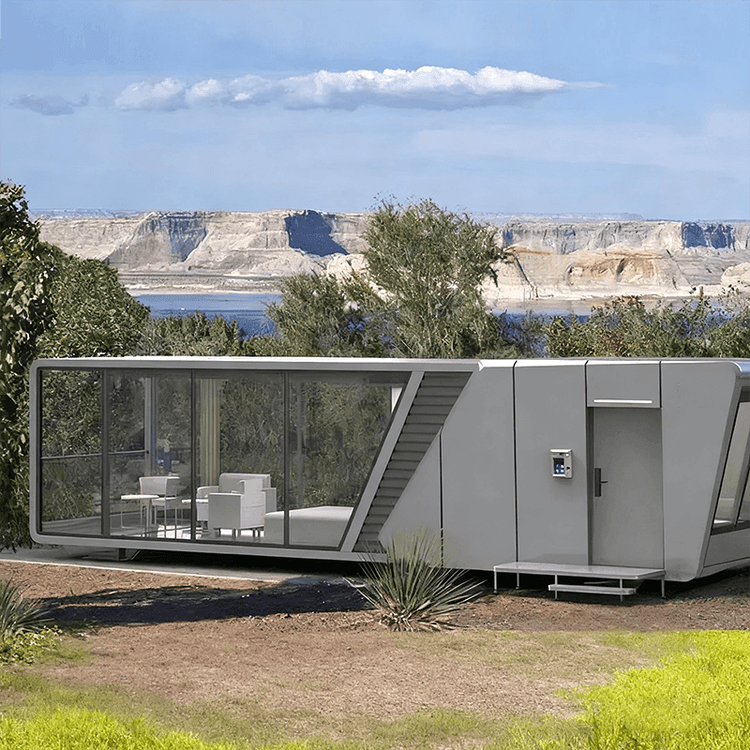
Container House Foundation Requirements
Container houses generally require foundations, but the requirements vary depending on the type.

Foldable container houses and fixed residential container houses have relatively low foundation requirements. These houses can be placed directly on a leveled ground surface. If conditions permit, pouring a cement floor and creating drainage ditches can enhance living comfort. Their design features a relatively simple structure with evenly distributed weight, resulting in low demands on ground bearing capacity, thus eliminating the need for complex foundation treatment.
Packing-box container houses have more flexible foundation requirements. Their foundation forms can be strip foundations, pier foundations, or even no specialized foundation, allowing direct placement on the ground. This flexibility stems from their modular design, where the house weight is transferred to the ground through corner fittings, resulting in low requirements for foundation uniformity and high adaptability.
Residential portable panel houses have higher foundation requirements. A concrete foundation of a certain area needs to be poured, and the house is fixed to the foundation using expansion screws. During demolition, the first-floor concrete foundation is usually not reusable. These houses have a relatively light structure but weak wind resistance, requiring a solid foundation connection to enhance stability and prevent displacement or overturning due to external forces.
Foundation requirements for container houses in special scenarios: If container houses are used for long-term residence (such as on rural homesteads), building approval must be obtained according to local requirements, structural drawings must be provided, and the foundation must meet permanent building standards. In this case, container houses are regarded as steel structures and need to be elevated using independent foundations (such as pile foundations) to achieve moisture resistance, insect prevention, and site leveling. If used for temporary construction (such as on leased land), the nature of use must be clearly specified in the contract, and foundation treatment can be simplified, but it must still meet safety requirements.
Core principles of foundation treatment: Regardless of the type, container houses should avoid being placed directly on the ground and should be elevated using foundations (such as pads or pier foundations) to prevent moisture at the bottom. For multi-story or staggered-stacked container houses, it is essential to ensure that the corner fittings are aligned and locked vertically and that vertical loads are transferred through a solid foundation to prevent structural instability.