
Container House Foot Welding
Four core aspects need to be focused on in container house foot welding: material selection, structural accuracy, welding process, and anti-corrosion treatment.
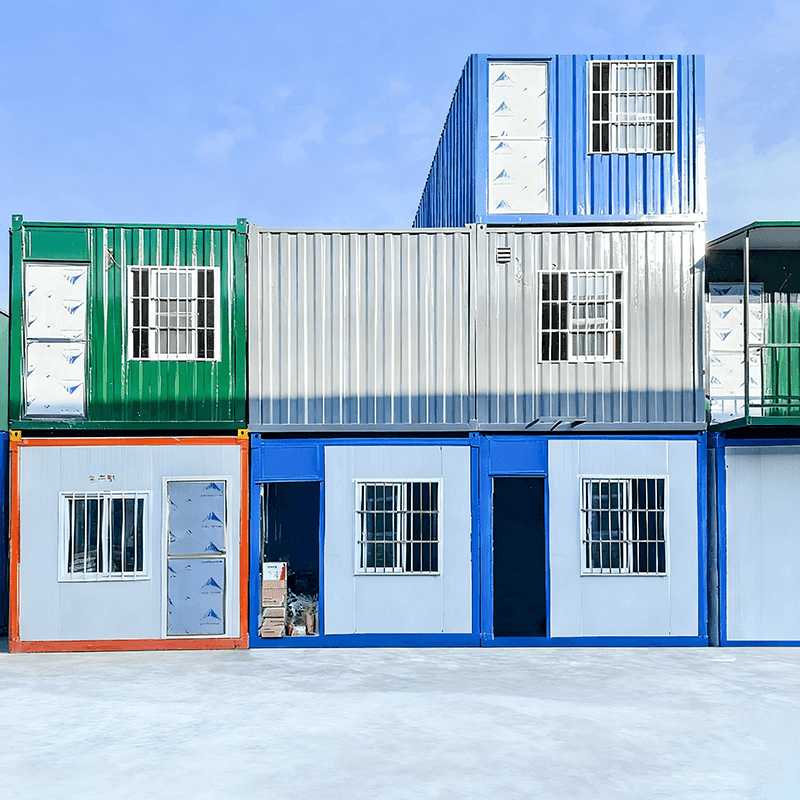
Material selection and structural accuracy are fundamental.
The framework of a container house is composed of channel steels, columns, and other profiled steels, and it is necessary to select steels that meet national standards. For example, channel steels (such as the 5X10 specification) are used for welding the main crossbeams around the upper and lower bases. The thickness of the columns should be no less than 1mm, and they should be pressed into shape using professional equipment or ready-made products from the market should be selected. Structural accuracy directly affects the stability of the house. The flatness error of the top and bottom frames should be controlled within ±2mm to avoid misalignment or water leakage risks during hoisting and assembly. In addition, parameters such as the diagonal error of the container body and the height of the weld toes should strictly comply with industry standards to ensure uniform stress distribution throughout the structure.
The welding process and equipment are crucial.
Modern container welding mostly employs automated equipment to improve accuracy and efficiency. For example, the Megmeet Artsen II PM500F welder uses a direct-current short-circuit process combined with dedicated machine welding to solve problems such as slow welding speed, unstable arcs, and excessive spatter. The Artsen Plus welder, designed for welding the base plate to the side panels, overcomes arc instability caused by anti-rust paint coatings through an intelligent gas-shielded welding process platform. Automated equipment such as infrared scanning and laser-tracking automatic welding technology enables high-precision control of side panel splicing and top longitudinal/transverse welding, reducing manual errors and enhancing welding quality.
Anti-corrosion treatment and durability design cannot be overlooked.
Container houses are often exposed to outdoor environments and require anti-corrosion processes to extend their service life. Mainstream methods include overall hot-dip galvanizing or spraying high-adhesion epoxy zinc-rich primers to prevent weld corrosion and structural cracking. For example, high-end manufacturers use basalt wool color-steel composite panels as insulation layers, which have a thermal conductivity coefficient lower than 0.040W/(m·K), remain physically stable in environments ranging from -30℃ to 70℃, and have a fire rating of Class A, combining thermal performance with durability.
Application scenarios and customized requirements need to be matched.
Container houses have a wide range of uses, from temporary offices to cultural and tourism complexes, and their designs need to be adjusted according to the scenario. For example, homestay renovations require the integration of non-standard structures such as large-span glass curtain walls and folding balconies, along with elevated reinforcement designs for mountainous or beach terrains. Industrial equipment container houses, on the other hand, use high-strength bolt connections instead of electric welding to achieve environmental protection, low carbon emissions, and multiple disassembly and reuse.



