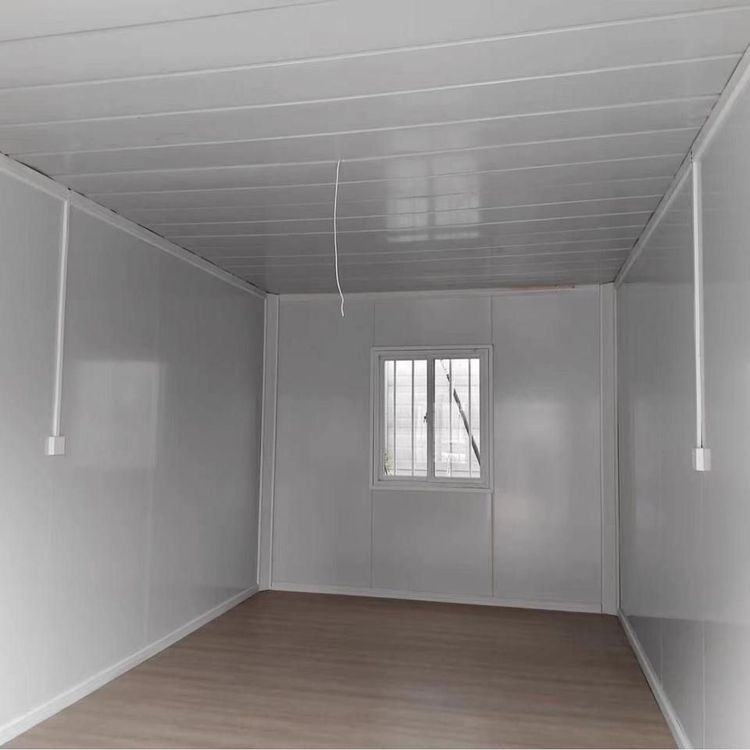
External Insulation for Container-Modified Houses
External insulation for container-modified houses can achieve efficient thermal insulation through reasonable material selection, standardized construction, application of innovative technologies, and attention to detail.

Material Selection Should Be Adapted to Local Conditions
Different application scenarios require matching different insulation materials. In extremely cold regions, polyurethane foam with a thermal conductivity as low as 0.020 - 0.025 W/(m·K) is preferred due to its closed-cell structure, which effectively blocks heat transfer. For scenarios with high fire safety requirements, Class A fire-resistant rock wool boards are the top choice, with a thermal conductivity of 0.040 - 0.045 W/(m·K) and a water absorption rate of ≤1.0%, offering both fire resistance and moisture resistance. In humid environments, extruded polystyrene boards (XPS) are preferred due to their closed-cell rate exceeding 95% and excellent waterproofing. For projects with limited space, vacuum insulation panels can be selected, as their 20mm thickness can achieve the same insulation effect as traditional 100mm rock wool, significantly saving space.
Construction Techniques Should Be Standardized and Rigorous
Foundation treatment is crucial: The wall surface flatness deviation should be controlled within 5mm, and the seams between container house panels should be filled and sealed with polyurethane foam to prevent the formation of thermal bridges that lead to heat loss.
Insulation layer installation should be selected based on material characteristics: XPS boards are adhered using a polymer cement adhesive dot-and-frame method, supplemented with anchors to enhance stability; rock wool boards are fixed with galvanized brackets and laid in a double-layer staggered pattern to prevent sagging and thermal bridges; vacuum insulation panels require their edges to be sealed with special tape to prevent vacuum failure.
Protective layer construction should be layered: Anti-crack mortar combined with alkali-resistant mesh cloth enhances crack resistance, with the first layer reinforced with double mesh cloth; the exterior finish can be selected based on needs, such as elastic coatings or metal carved panels, balancing aesthetics and durability.
Innovative Technologies Can Enhance Performance
Phase change material composite insulation systems regulate indoor temperature fluctuations by absorbing or releasing heat through material phase changes, reducing air conditioning energy consumption. Air layer insulation technology utilizes the thermal pressure principle to accelerate air circulation, carrying away surface heat and enhancing insulation effects. Photovoltaic integrated insulation systems combine photovoltaic panels with insulation layers to achieve dual functions of power generation and insulation, suitable for regions with abundant sunlight.
Detail Handling Should Be Comprehensive and Thoughtful
Adopt a "vapor barrier + insulation layer + breathable layer" structure, where the vapor barrier prevents indoor moisture from infiltrating the insulation layer, and the breathable layer expels moisture from within the insulation layer to prevent condensation. The adhesive-anchor combination process uses both adhesive and anchors for double fixation to prevent insulation layer detachment. Areas such as corners and window/door openings require reinforcement, such as adding mesh cloth or additional insulation layers, to eliminate thermal bridge risks.