
Back to blog
Article
Exterior Wall Insulation of Container Houses
Admin September 16, 2026
Exterior wall insulation of container houses can be achieved by selecting appropriate materials, adding insulation layers, optimizing processes, paying attention to details, and applying innovative technologies. Details are as follows:
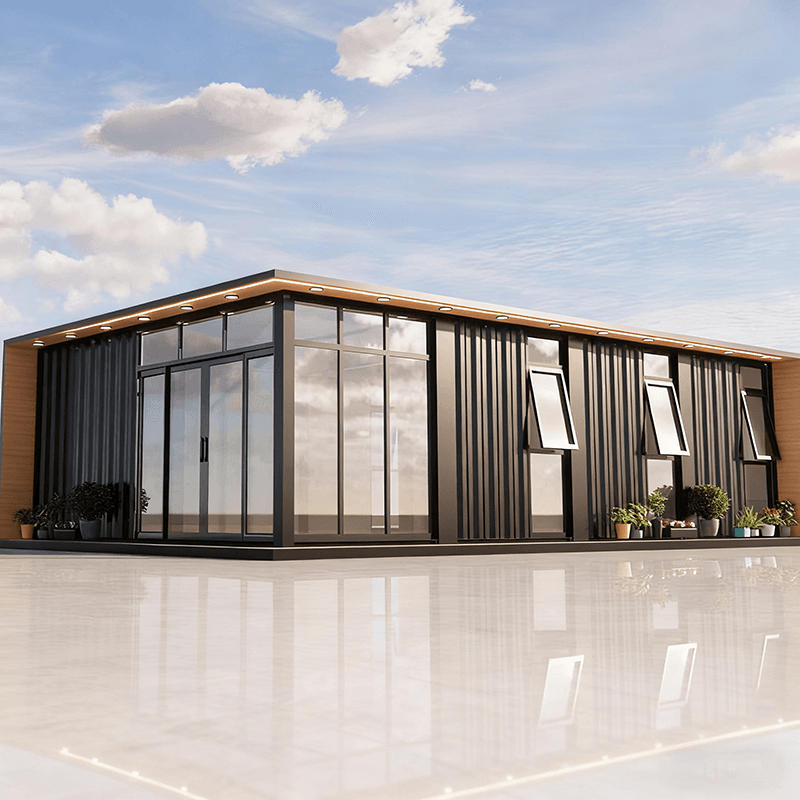
I. Selecting Appropriate Thermal Insulation Materials Choose materials based on the requirements of the usage scenario:
- Cold Regions: Prioritize polyurethane foam with a thermal conductivity as low as 0.020 - 0.025W/(m·K). Its closed-cell structure effectively blocks heat transfer.
- Scenarios with High Fire Safety Requirements: Rock wool boards with Class A fire resistance are the preferred choice. They have a melting point exceeding 1000℃ and also offer sound absorption and noise reduction functions.
- Humid Environments: Extruded polystyrene boards (XPS) are suitable due to their closed-cell rate exceeding 99% and water absorption rate below 1%, preventing a decrease in insulation performance caused by moisture.
- Projects with Limited Space: Vacuum insulation panels, with a thickness of only 5-30mm and a thermal conductivity as low as 0.004W/(m·K), are ideal for scenarios sensitive to thickness, such as old building renovations.
II. Adding Thermal Insulation Layers Construct thermal barriers through external hanging or internal embedding methods:
- External Hanging Insulation Layers: Install insulation boards on the exterior surface of the container to form a continuous thermal insulation layer, reducing thermal bridge effects.
- Internal Thermal Insulation Boards: Install insulation materials on interior walls, suitable for scenarios with special architectural appearance requirements, but note the issue of indoor space occupation.
III. Optimizing Construction Processes
- Foundation Treatment: The wall flatness deviation should be controlled within 5mm. Container panel seams should be filled and sealed with polyurethane foam to avoid the formation of thermal bridges.
- Insulation Layer Installation: XPS boards should be pasted using the polymer cement adhesive dot-frame method, supplemented by anchors to enhance stability. Rock wool boards should be laid with double-layer staggered joints using galvanized brackets to prevent sagging and thermal bridges.
- Protective Layer Construction: Anti-crack mortar should be used in combination with alkali-resistant mesh cloth. The first layer should be reinforced with a double layer, and finally, elastic paint or metal carved panels can be selected for decoration according to requirements.
IV. Paying Attention to Detail Handling
- Joint Sealing: Fill the joints between insulation materials with special sealant or foam to ensure no gaps.
- Structural Integration: Use elastic sealant or special connectors at the connection between the insulation layer and the container to avoid cracking caused by structural deformation.
- Around Windows and Doors: Fill the gaps between window and door frames and walls with insulation materials to reduce heat loss.
V. Applying Innovative Technologies
- Phase Change Material Composite Insulation Systems: Regulate indoor temperature fluctuations and reduce air conditioning energy consumption by absorbing or releasing heat through material phase changes.
- Air Layer Thermal Insulation Technology: Set up an air layer between the insulation layer and the exterior wall to remove surface heat through the thermal pressure effect.
- Photovoltaic Integrated Insulation Systems: Combine photovoltaic panels with insulation layers to achieve dual functions of power generation and insulation.



